Showing posts with label Asia. Show all posts

Tuesday, 1 July 2025

What's in my drink, honey?

From indiatoday.in 

By Gagan Sharma

The world is in a ‘shaken and stirred’ mode, with cocktails turning heads and headlining bar menus with everyone eager to experiment. Breaking down the idea of a cocktail: a mix of spirits, often mixed with citrus and sugars, allows an examination of each part in its entirety. With increasing interest and exposure, there are growing debates about every element that makes your drink. While you can’t ignore the spirits, it’s the sugar that’s often at the centre of a long-standing parley—‘is honey any healthier than plain sugar’? Well, sugar is sugar, but who’s drinking cocktails for health anyway, right? Yet, there’s an uptick in the use of several varieties of honey in cocktails and conversations, and it’s Asia that’s setting global benchmarks. And championing this change, while spreading the gospel of honey, is the continent’s first meadery, Moonshine Meadery in Pune and bars like Bar Trigona in Kuala Lumpur, Asia Today in Bangkok, and, of course, Cobbler & Crew in Pune.
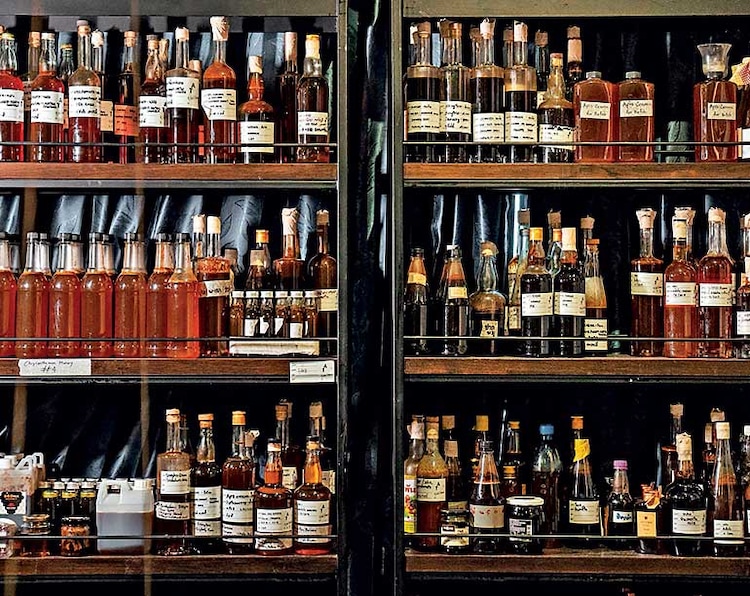
Library of honeys at Bar Asia Today

WHY HONEY?

If sugar is sugar, how can one make it better? The answer still lies with honey. Of course, there’s no biological benefit of switching to honey in cocktails, however, there’s the idea of sustainability, diversity, and community building, which barely comes at an additional cost. But cheaper isn’t always better; imagine your Old Fashioned made with Royal Stag instead of Royal Salute, or think of block ice becoming the norm instead of a cube or bullet ice which is now considered obsolete. You get the point.

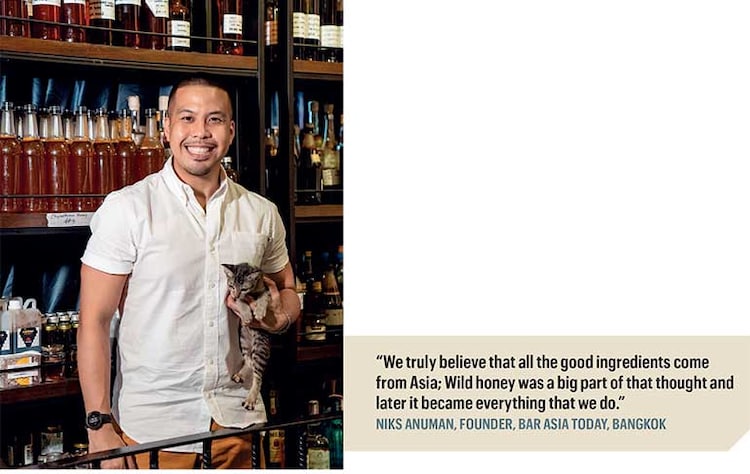
Niks Anuman founded Bar Asia Today in Bangkok eight years ago as a non-supermarket project. He says, “We truly believe that all the good ingredients come from Asia, hence Asia Today. Wild honey was a big part of that thought and later it became everything that we do”. One of India’s finest exports to Malaysia, Rohan Matmary, is the Beverage Manager at the Four Seasons Hotel in Kuala Lumpur that homes Bar Trigona. It takes pride in showcasing only natural products across all their drinks. “Bar Trigona proudly uses only Malaysian ingredients. Trigona honey was widely used in tribal homes; we teamed up with farmers and refurbished their hives, which have multiplied over the last seven years. Now we use it across the hotel, making it a popular feature again,” says Matmary.
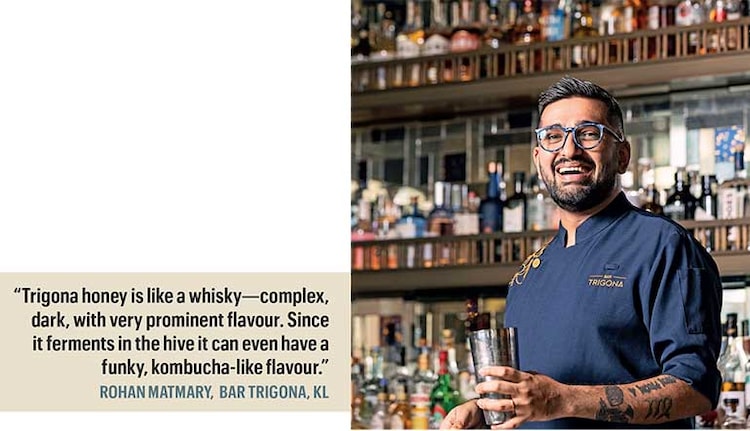
Rohan Matmary has championed Trigona honey to make it the centerpiece at Bar Trigona

WHY HONEY IS RIGHT ON THE MONEY

More than just an additive to sweeten cocktails, Cobbler & Crew—a bar in Pune—was the first to completely run on honey. Mayur Marne co-founded the place and claims honey’s superiority for its varied textures, sweetness levels, complexity, colour, and application, over sugars. He claims guests have never asked to replace honey with sugar in their drinks. “They’re receptive to the switch, appreciate the improved texture, and the opportunity to explore different kinds of honey. We offer honey tasting which draws the guests further in and makes them see it as a diverse ingredient”, he shares.
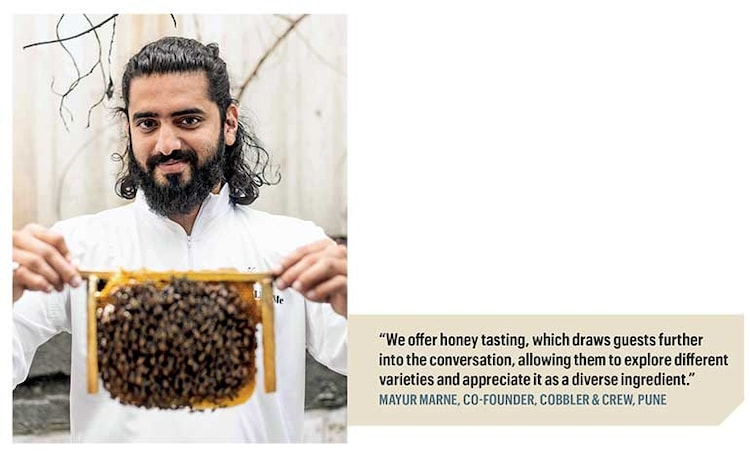
Cobbler & Crew, Pune, Mayur Marne of C & C, with a hive from their Bee Hotel Mayur Marne of Cobbler & Crew, Pune, with a hive from their Bee Hote

The utility of honey is a study by itself —- source of the honey, its moisture content, how it’s stored, how quickly it ferments, and lots more. The majority of our honey knowledge comes from bulk, supermarket brands. And trust me, most of what we know is incorrect. I was born allergic to honey, only to realise I’d been consuming fake bottled honey all my life. It was only after tasting pure honey, I realised I wasn’t allergic to honey but probably to the chemicals used in a majority of the big-label brands. Whatever we’ve been fed has been a result of what works for corporate giants. For instance, pure honey never crystallises; wrong, all types of honey does. It shouldn’t ferment on its own, incorrect, much like all sugars, it does spoil too. Wild hives in the park in front of your house, or in the back alley is consumable. Apparently, not. Honey doesn’t mix with water, yes it does, and that’s how all bars make honey syrup or honey water to add to cocktails. The darker the honey, the better it is; not really. You get the gist. Thus, the utility of honey, for a professional, solicits as detailed an understanding as do whiskies, agave spirits, or wines. Matmary concurs: “Different varieties of honey have different characters. Trigona honey is like a whisky—complex, dark, with very prominent flavour. Since it ferments in the hive it can even have a funky, kombucha-like flavour”. Who would have thought.

Just like various style of alcohols, decoding the styles of honey is imperative. It is as diverse an ingredient as any other. Rather than looking at honey as a loosely grouped term of nature’s favourite sugar, it should be the title of a book worth reading. For now, Nitin Vishwas, co-founder of Moonshine, Asia’s first meadery, shares the cheat-codes. “The type of honey decides the end result. Multifloral honey gives fairly neutral flavours. If you want a citrus twang, turn to Mustard honey, for caramel notes, Sidr works well, and for just a dash of sweetness, there’s Acacia. There are other types of honey too that can be complex and experiential such as the ones from the Sundarbans, Konkan belt, and Mahabaleshwar”, he explains.

What’s more, shares Matmary: “As compared to sugar, honey offers a lower Glycaemic Index (GI)—a measure of how quickly a food raises blood sugar levels compared to pure glucose—delaying your inebriation quotient, thus allowing you to hold your liquor for a longer time and hence drink more”. I’d drink to that.

ADVOCATING FOR BEES

While these bee-advocates have taken matters into their own hands and made it easier for you to participate in this bee-and-honey revolution. Here are some points to ponder: There are 350 types of bees, but only a couple of species make honey. The more urban we get, their habitat disappears. Hence, it becomes imperative to take care of them, which is why “Moonshine started the concept of ‘Bee Hotels’. We install bamboo pipes in societies with flowering plants, which allows a safe-haven for bees, allowing them to cross pollinate”, claims Vishwas. Cobbler & Crew homes a bee hotel too. “We’ve installed one in our outdoor section. It provides shelter for bees during extreme weather conditions and in exchange, engages guests to further the conversation and understanding around their habitat”, adds Marne.
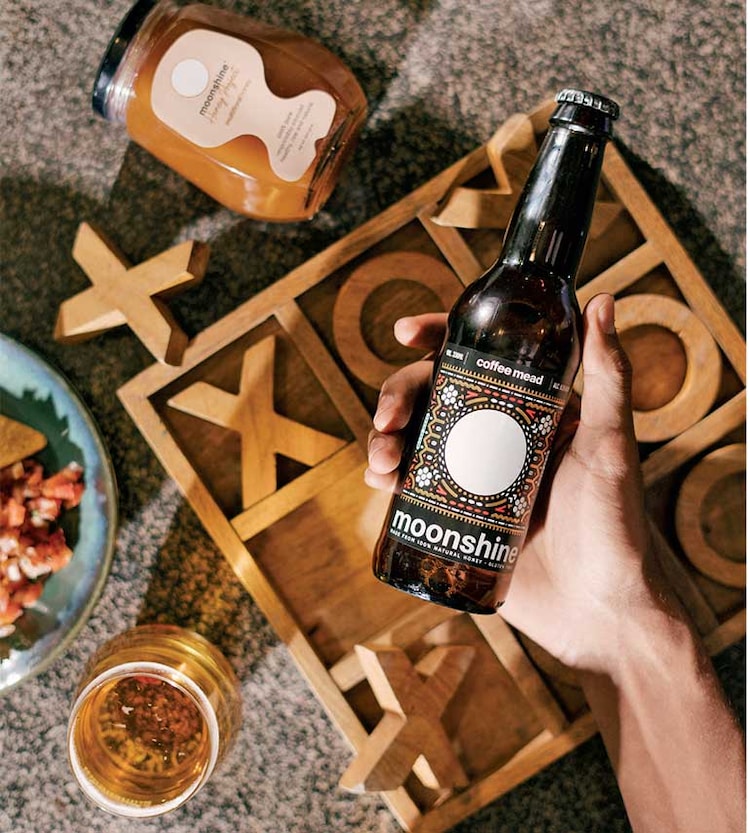
Asia’s first, Moonshine Meadery, uses flavour bridges to make meads more acceptable

Bar Trigona goes a step further and actually encourages people to adopt a bee hive of their own. “We adopt a beehive, nurture and operate it for a year. Whatever is collected from that hive, we pack and store it for the guest to collect at the bar. It creates an emotional connect for them, for nurturing a living thing, and in turn, all the money goes to the farmer. We currently have 600 adopted hives, and that’s a lot!” claims Matmary.

In Bangkok, Anuman and his team bring people to the mountains, where they show them how honey is harvested. “It demonstrates to our guests how the environment and bees are in total sync. Our house project called the ‘Sanctuary Project’ provides a variety of stingless bee species (hives and boxes) to our edible flower suppliers/growers. In exchange for our bees pollinating her flowers, we get a chance to observe and learn about them at close quarters”, he shares.

Einstein once said ‘If the bee disappeared off the surface of the Earth, man would only have four years left to live’. If that’s the case, then it isn’t about cocktails, sustainability, price, a sweetener, or the texture of your cocktail. It’s about survival, doing the right thing for the environment, and for the next generation. And that’s a thought that you may want to raise a toast to.

https://www.indiatoday.in/magazine/supplements/spice/story/20250707-whats-in-my-drink-honey-2747057-2025-06-28

Wednesday, 7 May 2025

Wyoming Businesses Expand To Asia Markets That Can’t Get Enough Cowboy Culture

From cowboystatedaily.com 

More Wyoming businesses are finding eager buyers for their products in Asia markets that can’t get enough cowboy culture. That success has the state exploring more ways to bolster Wyoming trade with countries in Asia

Wyoming and southeast Asia aren’t exactly two peas in a pod, but the cowboy culture has a way of bringing together people of disparate backgrounds.


A handful of small Wyoming companies are expanding their businesses to Taiwan and southeast Asia and are experiencing great success there.


“There’s an allure to the West, into Wyoming and that kind of cowboy ethos, which made a pretty good transition for building a new market,” said Sam Clikeman, owner of Big Lost Meadery. 

So much so that Gov. Mark Gordon gave them a shoutout during a press conference last week after touring the region.


Gordon said the small to medium nature of these businesses blends well with the Taiwanese economy, which is predominantly made up by these sizes of businesses. “It’s just very exciting to see those kinds of efforts on the small-medium enterprise front that are coming to fruition in Taiwan,” he said.


A big reason behind this success can be credited to the Wyoming - Asia Pacific Trade Office, which was established in Taiwan in 2018 to help promote exchanges in agriculture, technology, tourism and education. Its director Chester Chu has been instrumental in facilitating partnerships with Wyoming brands in his homeland.


“The state of Wyoming has helped initiate us and many other businesses to get that going,” said Powell resident Seaton Smith, CEO and co-founder of LEO Verification Systems, which are manufactured in Taiwan.


Sam Klikeman, left, showcases his Big Lost Meadery product in Taiwan. The labels are designed specifically for the overseas market. (Courtesy Photo)


Taiwan had been due to be hit with a 32% U.S. import tax until President Donald Trump last month put all his reciprocal tariffs on pause for 90 days. 


Taiwan's government said Saturday that it had recently concluded its first round of "substantive" tariff talks with the United States, describing the atmosphere as frank and cordial, Reuters reported. Taiwan has responded to Trump's tariffs by proposing a zero-tariff regime and offering to massively ramp up purchases from and investment in the United States.


Big Lost Meadery

Big Lost Meadery in Gillette is selling its mead in Taiwan and Hong Kong, which Clikeman describes as part of his mission to bring mead to the world, “one step at a time.” 


Mead is an alcoholic beverage made by fermenting honey with water and yeast, also sometimes known as "honey wine." An obscure off-branch of alcohol, mead is usually an item limited to at-home settings

Selling this product for the first time, Clikeman described as creating a brand-new market not only in Asia but everywhere.


“Mead is not a well-known or well-consumed product,” he said.


The Taiwan trade office helped Big Lost get into some trade shows out in Taiwan where the company was able to start making connections. Promoting the brand in Taiwan, Clikeman said, is an enjoyable experience as they sometimes get to do cross-promotion with other Wyoming brands trying to make it big there.


“We get to go out there and sell the concept of Wyoming, not just what it is that we do,” he said.

After laying the groundwork for selling their mead out there in 2019, plans to distribute the product in March 2020 fell apart with the start of the COVID-19 pandemic. Clikeman started revisiting the opportunity in 2023 and this time the venture clicked. Now, they’re already looking at expanding further into Asia.


Although it doesn’t make up a significant portion of their revenue now, Clikeman said they expect that to change in the next 6 months-1 year because of a rebrand they just released for the Asian market. 

Recently, Big Lost unveiled new labels specifically for its Taiwanese-sold products of its Crazy Woman, Wild Man and Forgotten Philosopher meads to better match the Asian clientele, while still showcasing their product’s Western roots. 


“It’s actually a little more Greek but still has the Wyoming ethos behind it,” Clikeman said.

Their Taiwanese product labels are still written in English, which Clikeman said is critical for American goods sold there, in order to differentiate themselves from American brands sold in China.

“Which has a very different connotation,” he said.


Big Lost also just expanded domestically as well, recently opening their second brewery in Sioux Falls, South Dakota. 


Backwards Distilling Co. of Casper is also very popular in Taiwan, Gordon said.


https://cowboystatedaily.com/2025/05/06/wyoming-businesses-expand-to-asia-markets-that-cant-get-enough-cowboy-culture/

Saturday, 9 September 2023

Moonshine Meadery: Creating a Buzz

From indiaretailing.com 

Meet Pune-based Moonshine (not only India’s but also Asia’s first meadery), which is experimenting with ingredients to bring the most unique variants of mead to an ever-increasing clientele

Story of growth 

Rohan Rehani and Nitin Vishwas are the co-founders of Moonshine Meadery. It was around 2014 that the duo realised there was an audience looking for a more flavourful choice of beverage. So, they did some research and found that mead fits into the white space that exists between flavourful, non-alcoholic beverages such as Coke and alcoholic bitter beverages such as commercial beer. “This was when we started contemplating if we could start a meadery. At that time, the Indian market did not have an alcoholic beverage that was focused on flavour,” shares Rehani. Unfortunately, there was also no excise policy around mead then. “It took us nearly two years to get a change in the state government’s excise policy, and a few months after that, we got the license to start India’s first meadery,” reveals Rehani. Moonshine Meadery was commercially launched in 2018.

Innovation at the core 

The category that Moonshine is disrupting is commercial beer. For decades, consumers have had to choose between one bitter beverage and another, with no option for a flavourful beverage. Mead, though, is flavourful right out of the bottle, and to showcase this, Moonshine offers a diverse range of meads—fruit forward, mildly sweetened with honey and carbonated. “Moonshine is all about innovation. When we discovered that mead is an extremely versatile beverage, we started using ingredients such as apples, coffee and grilled pineapples to add extra flavour to the drink,” shares Vishwas. The brand’s flagships meads are traditional mead, apple mead and coffee mead, which are available throughout the year. 

Also on offer are limited-edition seasonal meads such as guava chilli mead, grilled pineapple mead and salted kokum mead, made in small batches using single-variety honey sourced from Moonshine’s own bee boxes, as part of its MeadLAB series. “The idea behind creating MeadLABS was to drive home the point that we offer craft beverages made from real ingredients. We are giving consumers a choice to drink better, not bitter. Our most recent MeadLab is the hopped mead, made with multi-floral honey and a mix of Amarillo, Mandarina, magnum and Citra hops [hops are bittering, flavouring, and stability agents]. This mead is fruity and citrusy with a slightly bitter finish,” adds Vishwas. Since Moonshine only uses all-natural ingredients in its meads, its consumers can easily make out the difference between artificially flavoured meads and the brand’s meads. “This focus of crafting flavourful beverages using all-natural ingredients did not exist in the Indian alco-bev space before this. Our clientele thus majorly comprises consumers who were earlier drinking commercial beers but are now choosing our meads because they find them more flavourful,” explains Vishwas. 

Moonshine’s meads are not only flavourful but also contain low alcohol with only 6.5% abv (alcohol by volume), are mildly carbonated and packed in a 330 ml glass bottle much akin to a beer—unlike meads around the world. “This has worked well for us since doing this has made an old beverage like mead, young again. Another USP our meads have is that they are naturally gluten-free, so they will not give you a bloated stomach after consumption,” shares Vishwas.

Being customer ready 

Over the years, as Moonshine has grown, customer feedback has become very important to it. “For the most part, sales in the alco-bev sector happen through distribution channels. But we participate in events or host tours of our meadery to meet and speak to customers. We also occasionally invite them to participate in round table discussions with us,” says Rehani.

Launching new products is part of Moonshine’s DNA. “We release new flavours every few months as a part of our MeadLab series. Last year saw the release of our Grilled Pineapple Mead and the Salted Kokum Mead. This year, you will have to wait—there are quite a few new meads in the pipeline,” says Vishwas. 

https://www.indiaretailing.com/2023/09/08/moonshine-meadery-creating-a-buzz/

Friday, 25 August 2023

Moonshine Meadery Expands its Flagship Mead Series; Launches Lemon Tea Mead

From restaurant.indianretailer.com

Moonshine has further partnered with Malaka Spice to resell their zested lemon to promote zero waste and intends to initiate more such partnerships with other restaurants in Pune


Asia and India’s first meadery, Moonshine, has launched a refreshing new edition to their flagship series: Lemon Tea Mead. 

The Mead is made with lemon zest and Vahdam’s Earl Grey tea. Moonshine is on a mission to save the bees and immerse itself in better beekeeping practices, sip by sip.

Conceptualized to transcend seasons, Lemon Tea Mead presents a harmonious combination of flavors - lemon zest and VAHDAM India's Earl Grey tea. 

Priced at an enticing Rs 150 in Maharashtra throughout the year, this offering is an invitation to newcomers, enriching their perception of meads. 


Moonshine has further partnered with Malaka Spice to resell their zested lemon to promote zero waste and intends to initiate more such partnerships with other restaurants in Pune. 

“In the previous year 2022-2023, Moonshine achieved a remarkable feat, using over 55 MT of honey for crafting both mead and retail honey sales. What's fascinating is that it takes around 4 million flower visits by bees to produce just 1 kg of honey. So, with our consumption of 55 MT of honey, we've essentially played a part in supporting the pollination of a staggering 220 billion flowers. So, we are taking one pint at a time and pushing more mead with less price. Our goal is to consistently weave a narrative that highlights Moonshine's commitment to ecological balance through the preservation of bees and dedicated beekeeping practices,” shared Rohan Rehani, Co-founder, Moonshine Meadery and Moonshine Honey Project.

In the alco-bev industry, Moonshine Meadery stands as the only brand that looks after ecological balance. With every pint of moonshine, a remarkable ~ 4 million flowers are pollinated. In a landscape where few alcohol brands champion social and environmental causes, Moonshine's conscious commitment shines brightly, redefining the industry's role in fostering a better world.

https://restaurant.indianretailer.com/news/moonshine-meadery-expands-its-flagship-mead-series-launches-lemon-tea-mead.n21202 

Saturday, 4 September 2021

Honey Wine Market - Business Overview

From unlvrebelyell.com

Honey Wine Market: Overview

Exceptional nutritional and antimicrobial properties make honey wine one of the favourite drinks among a considerable populace. This aspect may drive the growth of the honey wine market during the forecast period of 2019-2029. Honey wine, also known as mead, is wine that’s fermented using honey. The growing influence of finely brewed wines with various infusions is bringing tremendous growth prospects for the honey wine market.

This honey wine market report analyses various factors that assist in scaling up the growth graph. Some significant factors such as key trends, mergers and acquisitions, and the geographical perspective of the honey wine market have been studied with scrutiny in this report. The stakeholders can gain extensive knowledge from this report on the honey wine market. In addition, this report also carries an analysis of the COVID-19 impact on the honey wine market.

Honey Wine Market: Competitive Landscape

The competition in the honey wine market is stiffening day by day as the numbers of meaderies across the globe are increasing at a rapid rate. In 2017, the American Mead Makers Association (AMMA) found out that during an 18-month period, a meadery was opened every three days in the U.S. and every seven days around the world. These statistics show the heightened competition in the honey wine market.

Through investing in research and development activities, the players in the honey wine market are gaining information on novel formulations that will successfully cater to the taste buds of the populace, especially among the millennials and generation-Z. These activities also offer insights into making the wine cost-effective for building a strong consumer base.

Some prominent participants in the honey wine market are Brothers Drake Meadery, Gosnells Beverages Ltd., Kuhnhenn Brewing Co. LLC, Medovina Meadery, Redstone Meadery, and Schramm’s Mead.

Honey Wine Market: Diverse Varieties and Their Growth Contributions

The honey wine market may gain an upper hand in growth during 2019-2029 due to the varied varieties of mead available in the market. Here are some significant mead varieties that help in boosting the growth rate of the honey wine market.

Cyser: It is a blend of apple and honey together. Lyme Bay Winery recently launched the Jack Ratt Cyser mead to increase its presence among the young generation.

Acerglyn: It is a type of mead infused with maple syrup. The Kettle Ridge Farm recently entered the honey wine market and launched Delaney Jo, an acerglyn.

Bochet: In this type, honey is burned separately before adding water to create chocolate, roasted marshmellows, or toffee flavors. Two Warriors Meadery, the first meadery in the state of Louisiana, plans to launch bochet and the owners claim that it is the most-intensive recipe they make. The recipe is from the 1390s and has won much recognition.

View Complete Overview Of The Report @https://www.tmrresearch.com/honey-wine-market

 Honey Wine Market: Regional Analysis

The honey wine market can be geographically segmented into North America, Latin America, the Middle East and Africa, Europe and Asia Pacific. Europe may serve as the largest regional growth contributor for the honey wine market between 2019 and 2029. The growing popularity of honey wine and the escalating number of meaderies in developed countries may prove to be a significant factor of growth. North America may also gain substantial growth due to the increasing number of meaderies across the U.S.

Asia Pacific may show great potential for growth across the forecast period due to the penetration of meaderies in the region. For instance, India has its first meadery in the form of Moonshine Meadery in Maharashtra. In addition, the trend of crafted beers and wines is rapidly growing in the region and this aspect may prove to be a turning point for the growth of the honey wine market.

About TMR Research:

TMR Research is a premier provider of customized market research and consulting services to business entities keen on succeeding in today’s supercharged economic climate. Armed with an experienced, dedicated, and dynamic team of analysts, we are redefining the way our clients’ conduct business by providing them with authoritative and trusted research studies in tune with the latest methodologies and market trends.

https://www.unlvrebelyell.com/honey-wine-market-global-share-size-sales-volume-analysis-and-growth-by-2029/


Thursday, 12 March 2020

History of Mead

From heritagedaily.com

Mead or “honey-wine” is a fermented honey drink with water that has been produced for thousands of years throughout Europe, Africa and Asia.

Mead – “fermented honey drink” – derives from the Old English meodu or medu, and Proto-Germanic, *meduz. The name has connections to Old Norse mjöðr, Middle Dutch mede, and Old High German metu, among others.

The earliest recorded evidence dates from 7000BC, where archaeologists discovered pottery vessels from the Neolithic village of Jiahu in Henan province, China that contained the chemical signatures of honey, rice and compounds normally associated with the process of fermentation.

Mead became present in Europe between 2800 to 1800BC during the European Bronze Age. Throughout this period, the Bell Beaker culture or short Beaker culture was producing the “All Over Ornamented (AOO)” and the “Maritime Type” beaker pottery. The beakers are suggested to have been produced primarily for alcohol consumption, with some examples of these pottery forms containing chemical signatures for mead production.

         Bell Beakers from the Logabirumer Feld in Leer (East Frisia) – Credit : Hartmann Linge

During the Golden Age of Ancient Greece, mead “hydromeli” proceeded wine and was a stable beverage of Grecian culture. Hydromeli was even the preferred tipple of Aristotle, in which he discussed mead in his Meteorologica.

The German classical scholar, W. H. Roscher suggested that mead was even the nectar or ambrosia of the Gods. He compared ambrosia to honey, with their power of conferring immortality due to the supposed healing and cleansing powers of honey, which is in fact anti-septic, and because fermented honey (mead) preceded wine as an entheogen in the Aegean world; on some Minoan seals, goddesses were represented with bee faces (compare Merope and Melissa).

This is supported in the archaic versions of the stories of the gods. The Orphists preserve a tale about the cruel guile of Zeus who surprised his father Kronos when he was drunk on the honey of wild bees and castrated him.

Mead “aquamulsum” or just “mulsum” was also common during the Imperial Roman era and came in various forms. Mulsum was a freshly made mixture of wine and honey (called a pyment today) or simply honey left in water to ferment; and conditum was a mixture of wine, honey and spices made in advance and matured (arguably more a faux-mead).

The Hispanic-Roman naturalist Columella gave a recipe for mead in De re rustica, around 60 BCE.
“Take rainwater kept for several years, and mix a sextarius of this water with a [Roman] pound of honey. For a weaker mead, mix a sextarius of water with nine ounces of honey. The whole is exposed to the sun for 40 days, and then left on a shelf near the fire. If you have no rainwater, then boil spring water.”

Alcoholic drinks made from honey would become very popular within the Early Middle Ages and Medieval Europe. This was especially so among the Native Brythonic cultures, Anglo-Saxons, Germans, and Scandinavians. However, wines remained the preferred beverage in warmer climates in what is now Italy, Spain and France.

Anglo-Saxon literature such as Mabinogion, Beowulf and the Brythonic writings of the Welsh poet Taliesin (who wrote the Kanu y med or “Song of Mead ) describe mead as the drink of Kings and Thanes. In the Old English epic poem Beowulf set in Scandinavia, Beowulf comes to the aid of Hrothgar, the king of the Danes, whose mead hall in Heorot has been under attack by a monster known as Grendel.

In Chaucer’s Canterbury Tales – The Miller’s Tale, mead is described as the draught of townsfolk and used to court a fair lady. Chaucer also makes mention of spiking his claret with honey.
“He sent her sweetened wine and well-spiced ale
And waffles piping hot out of the fire,
And, she being town-bred, mead for her desire
For some are won by means of money spent
And some by tricks and some by long descent.”

                                      Geoffrey Chaucer’s Canterbury Tales – Public Domain

In later years, tax and regulation drove commercial mead out of popularity with beer and wine becoming the predominant alcoholic drinks. Some monasteries in England and Wales kept up the traditions of mead-making as a by-product of beekeeping but with the dissolution of the monasteries in the 16th century mead all but disappeared.

Finally, when West Indian sugar began to be imported in quantity (from the 17th century), there was less incentive to keep bees to sweeten foods and the essential honey to ferment mead became scarcer across Europe leading to its decline.