Showing posts with label bees. Show all posts

Saturday, 4 July 2026

Island to host Ireland’s first public mead-making experience

From advertiser.ie

A remote island on Ireland’s Wild Atlantic Way will become the home of what is believed to be Ireland’s first public mead-making experience when visitors gather on Inishturk Island on Saturday, July 11, to discover, taste and create one of humanity’s oldest alcoholic drinks.

Limited to just ten participants, the immersive experience will combine Irish history, traditional craftsmanship, premium Irish honey and hands-on fermentation, with every guest creating and taking home their own one-gallon (4.5 litre ) batch of mead.

The event is being delivered as part of the Taste of Inishturk Festival 2026 in conjunction with Wild Atlantic Mead and the Inishturk Native Irish Honey Bee Sanctuary. The festival celebrates the island’s unique culture, heritage, food, community and natural environment, bringing visitors to one of Ireland’s most spectacular offshore destinations.

The mead-making experience forms one of the festival’s flagship activities and offers visitors a rare opportunity to discover, taste and create Ireland’s oldest drink while experiencing life on a remote Atlantic island. 

Places are strictly limited to just 10 participants, and advance booking is essential. Tickets are priced at €135 per person and include return ferry travel, a two-course lunch, honey and mead tastings, all workshop materials and ingredients, and a one-gallon (4.5 litre ) batch of mead to take home.

Bookings can be made via https://inishturkisland.com and participants must be aged 18 years or over.

Mead, often known as honey wine, predates both beer and wine and is believed to have been consumed for more than 9,000 years. In Ireland, mead was associated with kings, warriors and hospitality, with references appearing throughout Irish mythology and early medieval history.

Ancient Irish kings are said to have celebrated with mead in the halls of Tara, while honey wine featured prominently in feasting, hospitality and ceremonial occasions throughout Irish history.

The drink is also closely associated with weddings and is widely believed to have contributed to the origin of the term “honeymoon”, when newly married couples were traditionally gifted honey wine following their wedding.

The experience will be led by Sean O’Connor, founder of Wild Atlantic Mead, founder of the Inishturk Native Irish Honey Bee Sanctuary, a member of the European Mead Makers Association and the Institute of Brewing & Distilling, and a long-time Irish beekeeper.

Participants will sample a range of premium Irish honeys and discover how different floral sources influence flavour, aroma and fermentation. Guests will learn the science behind mead-making, taste different styles of honey wine and gain practical hands-on experience creating their own batch using premium Irish honey. 

By the end of the workshop, every participant will leave with their own one-gallon (4.5 litre ) batch of mead and the knowledge required to complete the fermentation process at home.

Sean O’Connor said Ireland has an extraordinary mead-making heritage, yet most people have never tasted mead, let alone made it themselves.

“This experience is about reconnecting people with an important part of our history while showcasing the incredible diversity of Irish honey and the importance of our native honey bees.

“By the end of the day, every participant will have made their own batch of mead, gained an understanding of fermentation and taken home a unique product that they can enjoy months later. We believe there is nowhere better to do that than on a remote Atlantic island surrounded by nature,” he added.

The event also supports the work of the Inishturk Native Irish Honey Bee Sanctuary, established on World Bee Day 2026 to promote awareness of Ireland’s native black honey bee (Apis mellifera mellifera ).

The sanctuary forms part of a pioneering three-location monitoring project involving colonies in County Wicklow, County Mayo and Inishturk Island. Using BroodMinder hive-monitoring technology, researchers and beekeepers can compare colony performance across dramatically different Irish environments while sharing live hive data with the public.

Visitors attending the mead-making experience will also learn about the vital role honey bees play in biodiversity, food production and sustainable rural communities. 

https://www.advertiser.ie/galway/article/151584/island-to-host-irelands-first-public-mead-making-experience

Thursday, 25 September 2025

USA: Thistlerock Mead Company Aims for Sustainability with Net-Zero Mead Initiative

From finance.coin-turk.com

Overview

  • Thistlerock Mead Company pushes sustainable practices with net-zero goals.

  • Industries beyond beverages join the environmental mission for broader impact.

  • The global coalition aims to protect pollinators through diverse strategies.

 During the quiet days of the Covid-19 pandemic, John Kluge, an entrepreneur based in Virginia, realized the growing disconnection between people and the natural environment. His observations during these isolated months led him to establish the Thistlerock Mead Company. The company‘s mission is to not only craft honey wine but also promote sustainable practices across the beverage industry. By using regenerative agriculture and sustainable beekeeping, Thistlerock aims to be the first net-zero meadery in the United States. The company integrates solar electricity and utilizes 100 percent post-consumer recycled bottles.

In past discussions, Kluge has consistently highlighted the potential within the beverage industry to address broader issues like biodiversity. Thistlerock’s current initiative is a testament to this vision as it seeks to inspire environmental responsibility industry-wide. Previously, Kluge’s efforts were more localized but now aim to influence broader industry practices. Thistlerock plans to work with various sectors, expanding partnerships beyond beverage companies to include industries like fashion and technology, demonstrating the extensive reach of environmental responsibility.

What Are Thistlerock’s New Collaborative Efforts?

In collaboration with Bee:Wild and the advocacy group Global Citizen, Thistlerock is forging a coalition aimed at encouraging pollinator-friendly practices. This coalition strives to galvanize support for protecting rainforest areas and securing funding for conservation. Kluge stated,

“We are little—we can’t do this by ourselves,”

when discussing these new partnerships. The initiative underlines an urgent need given that honeybee colonies are expected to decline significantly according to studies, mainly due to environmental stressors and human activities.

How Are Other Industries Engaging?

Industries beyond the beverage sector are joining Thistlerock’s environmental mission. Companies from fashion to technology are participating, each contributing in unique ways to boost pollinator protection. For instance, Dubai Airport plans to communicate biodiversity messages to millions of travellers, highlighting the global reach and diverse nature of the campaign efforts. According to Eva Kruse, “They come to it from different sides,” indicating the multifaceted strategies participants bring to the campaign.

The Bee:Wild coalition encompasses a diverse range of strategies geared toward enhancing pollinator conservation and biodiversity. From signing petitions advocating pollinator rights to working with communities on urban rewilding projects, the collaborative effort includes innovative approaches to raise awareness. Kluge expressed,

“The hope is that progress builds progress, and we will inspire each other,”

indicating the initiative’s potential to continuously foster environmental consciousness.

John Kluge’s initiative encourages individuals and industries to think about daily dependencies on pollination. Beverages, food, and countless other items rely heavily on bees and similar pollinators. Such interdependence underscores the need for awareness and proactive measures to safeguard these essential creatures.

The commitment to sustainability evident in Thistlerock’s efforts mirrors a wider trend in industries toward environmental responsibility. By uniting companies under a common cause, the initiative not only focuses on immediate ecological concerns but also seeks long-term solutions beneficial to industries and ecosystems alike. As threats to pollinator populations like bees grow, efforts such as these are vital in combating biodiversity loss and promoting global ecological health.

https://finance.coin-turk.com/thistlerock-mead-company-aims-for-sustainability-with-net-zero-mead-initiative/

Thursday, 24 July 2025

Chicago meadery introduces new generation to ancient elixir

From fordcountychronicle.com

CHICAGO — Wild Blossom Meadery & Winery works to bring back an ancient elixir, testing out new and unique flavours all while paying ode to the bees that make this buzzworthy beverage possible.

Once known as the “nectar of the gods,” mead was a celebrated part of ancient cultures around the world, prized by Greek philosophers, Viking warriors, Egyptian priests and Chinese nobility alike. The fermented honey drink reigned supreme for thousands of years. But, with wine and beer emerging as simpler, less-expensive options, mead became a luxury lost to time. Aside from the occasional Renaissance fair, mead has not been part of modern life.

However, interest in this honey of a drink has grown in recent decades. Once a sign of status and privilege, today, mead can be found at wineries, craft breweries and retail stores everywhere. According to the American Mead Makers Association, the number of commercial meaderies in the U.S. grew from approximately 60 in 2003 to an estimated 650 in 2022 – and one of the first began right here in Illinois.

Everything Old is New Again

Clearly, mead is making a comeback, thanks to skilled meadmakers like Greg Fischer, owner of Wild Blossom Meadery & Winery in Beverly on the South Side of Chicago.

“We were Illinois’ first meadery,” Fischer says. “We started at this location in 2001, built up a good following and expanded into a world-class tasting room and winery.”

For a time, Fischer worked as a beekeeper, transporting bees around the country to pollinate crops. Conveniently, honey is one of the main ingredients in mead, so his beekeeping roots came in handy.

“My family grew apples in upstate New York, and we needed honeybees for pollination,” says Fischer, who first became enamoured with bees as a child. “That’s how I got so attached to bees.”

As a pioneer in Illinois’ mead industry, Greg Fischer believes the Midwest is poised to become one of the mead capitals of the world. Photo by Nathan Lambrecht/©Journal Communications

As a pioneer in Illinois’ mead industry, Greg Fischer believes the Midwest is poised to become one of the mead capitals of the world. Photo by Nathan Lambrecht/©Journal Communications

Today, he channels his love for bees into making buzzy beverages. Nestled against the Dan Ryan Woods, Wild Blossom Meadery’s location is both picture-perfect and productive.

“Instead of raising grapes, we raise honeybees,” Fischer says. “Instead of vineyards, we have forests and fields and meadows that we farm.”

He also maintains hives on the Marriott hotel rooftop and other locations in downtown Chicago, a surprisingly bee-friendly place.

“Chicago’s lakefront is just teeming with flowers,” he says. “Cities with parks and flowering trees often have more nectar sources than rural locations. Bees are one agricultural endeavour that can work pretty well in an urban environment.”

In the winter, Fischer’s bees become snowbirds. To protect them from Illinois’ increasingly volatile weather fluctuations, he transports his hives to Florida, where they make honey that hints of local botanicals like palmetto and orange blossom. In the springtime, Fischer’s bees help Michigan farmers boost blueberry production by as much as 40%.

The Art of Mead Making

After those busy bees do their job, it’s Fischer’s turn to roll up his sleeves. A relatively simple process, mead making takes approximately two weeks and three ingredients: honey, water and yeast.

During the first, or primary, fermentation, the yeast converts the honey to alcohol, creating a basic dry mead. During an optional secondary fermentation, the mead maker can add honey back into the batch to sweeten it up as well as flavors ranging from cranberry to chocolate.

By varying the amount of honey added to the water, the mead maker can adjust the alcohol content from very light to as much as 20%. Many people mistakenly assume all meads are sweet, but the varieties are endless.

“Mead can be dry, sweet, spicy – whatever you want it to be,” Fischer says. “It’s the ultimate craft beverage.”

Wild Blossom produces very dry meads comparable to pinot grigio as well as sweet varieties similar to port. None is more sought after than the Blueberry Nectar mead.

“After primary fermentation, we pump the mead over beds of blueberries, and it will ferment on that fruit again, which builds flavor and complexity,” Fischer says. “In the end, we get a really beautiful blueberry flavor with honey in the background. It’s better than eating blueberries.”

One can only wonder what the earliest mead drinkers would have thought of Wild Blossom’s more adventurous offerings. Fischer’s signature creations include the award-winning Chocolate Cherry Honey Buzz and PB&J, made by pumping mead over fresh-roasted peanuts, then co-fermenting it with Concord grapes.

“People are just dumbfounded by it,” Fischer says. “They say it’s like drinking a peanut butter and jelly sandwich.”


A Mecca for Mead

As a pioneer in Illinois’ mead industry, Fischer believes the Midwest is poised to become one of the mead capitals of the world.

“We’re the Prairie State, and we produce some of the best honeys in the world right here,” he says. “Our meads really do wow people.”

Meanwhile, Fischer stands in awe of his honeybees. They fly as many as 15,000 miles and pollinate up to 2 million new flowers to produce the honey needed for just one bottle of mead.

“Bees are just so amazing,” says Fischer, noting the concern of serious threats bees face, such as mites and the changing climate. “When they’re pollinating, they’re either producing more food or more seeds. That’s why mead is the most sustainable wine on earth.”

So, the next time you’re in the mood for merrymaking, grab a glass and rediscover what our earliest ancestors knew: Mead is something to celebrate, along with the hard work of pollinators.

“Mead production supports honeybees, so you can feel as good about drinking mead as you feel when you’re done drinking mead,” he says.

https://www.fordcountychronicle.com/articles/state/chicago-meadery-introduces-new-generation-to-ancient-elixir/ 

Tuesday, 1 July 2025

What's in my drink, honey?

From indiatoday.in 

By Gagan Sharma

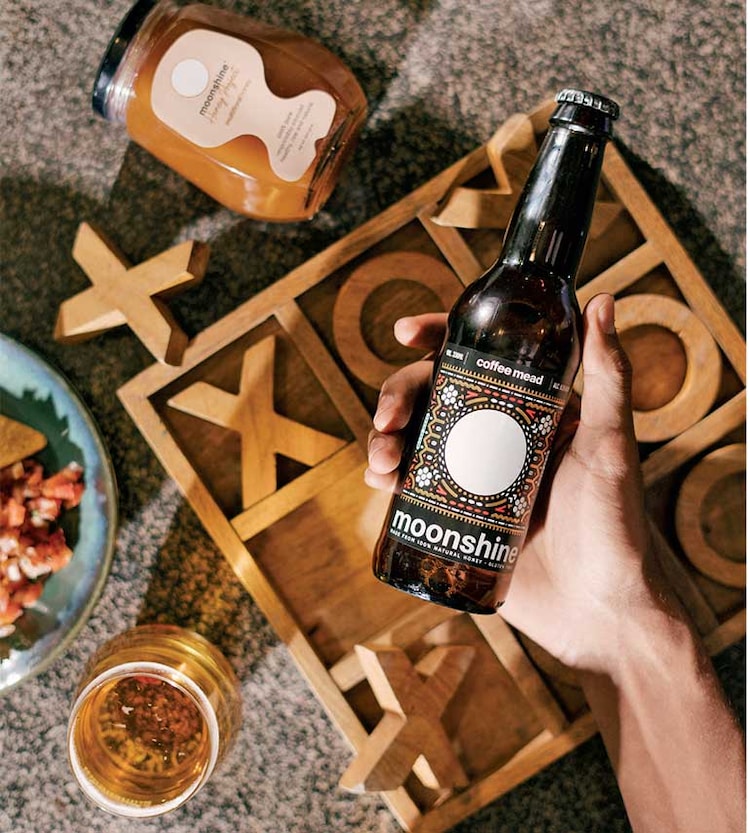
The world is in a ‘shaken and stirred’ mode, with cocktails turning heads and headlining bar menus with everyone eager to experiment. Breaking down the idea of a cocktail: a mix of spirits, often mixed with citrus and sugars, allows an examination of each part in its entirety. With increasing interest and exposure, there are growing debates about every element that makes your drink. While you can’t ignore the spirits, it’s the sugar that’s often at the centre of a long-standing parley—‘is honey any healthier than plain sugar’? Well, sugar is sugar, but who’s drinking cocktails for health anyway, right? Yet, there’s an uptick in the use of several varieties of honey in cocktails and conversations, and it’s Asia that’s setting global benchmarks. And championing this change, while spreading the gospel of honey, is the continent’s first meadery, Moonshine Meadery in Pune and bars like Bar Trigona in Kuala Lumpur, Asia Today in Bangkok, and, of course, Cobbler & Crew in Pune.

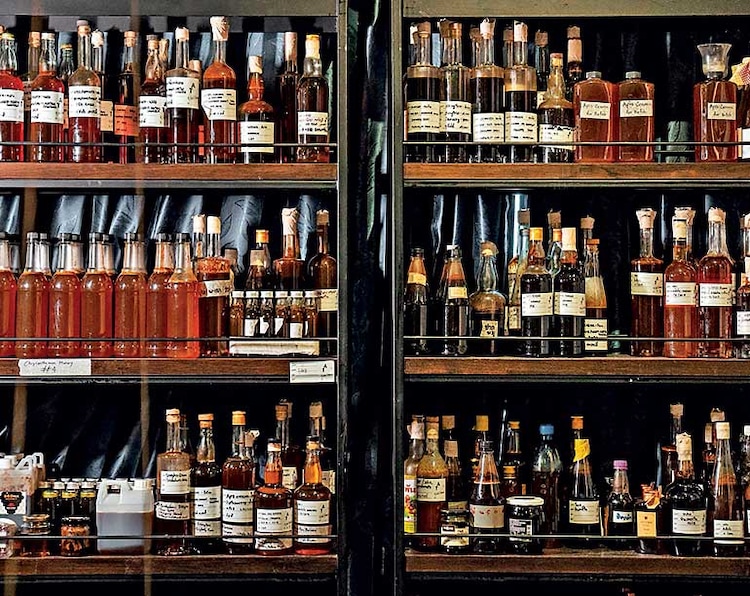
Library of honeys at Bar Asia Today

WHY HONEY?

If sugar is sugar, how can one make it better? The answer still lies with honey. Of course, there’s no biological benefit of switching to honey in cocktails, however, there’s the idea of sustainability, diversity, and community building, which barely comes at an additional cost. But cheaper isn’t always better; imagine your Old Fashioned made with Royal Stag instead of Royal Salute, or think of block ice becoming the norm instead of a cube or bullet ice which is now considered obsolete. You get the point.

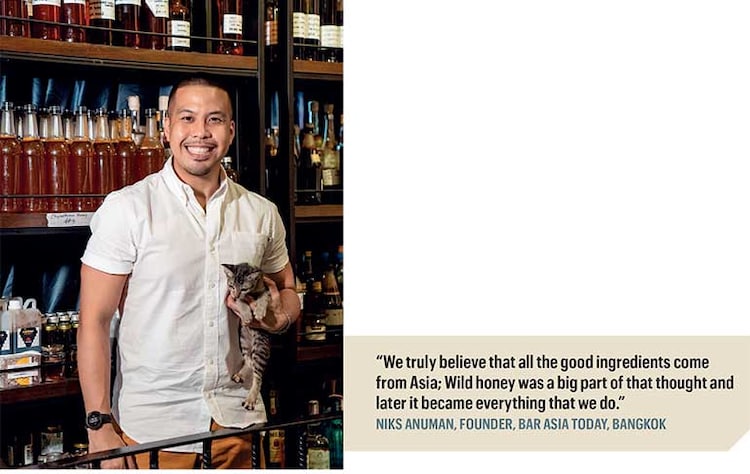
Niks Anuman founded Bar Asia Today in Bangkok eight years ago as a non-supermarket project. He says, “We truly believe that all the good ingredients come from Asia, hence Asia Today. Wild honey was a big part of that thought and later it became everything that we do”. One of India’s finest exports to Malaysia, Rohan Matmary, is the Beverage Manager at the Four Seasons Hotel in Kuala Lumpur that homes Bar Trigona. It takes pride in showcasing only natural products across all their drinks. “Bar Trigona proudly uses only Malaysian ingredients. Trigona honey was widely used in tribal homes; we teamed up with farmers and refurbished their hives, which have multiplied over the last seven years. Now we use it across the hotel, making it a popular feature again,” says Matmary.

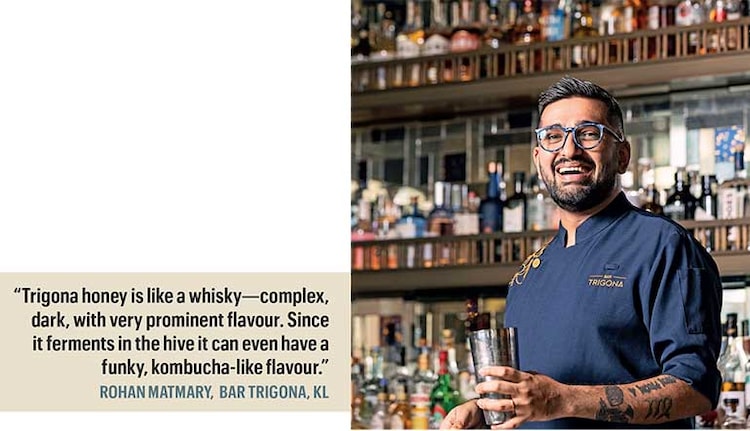
Rohan Matmary has championed Trigona honey to make it the centerpiece at Bar Trigona

WHY HONEY IS RIGHT ON THE MONEY

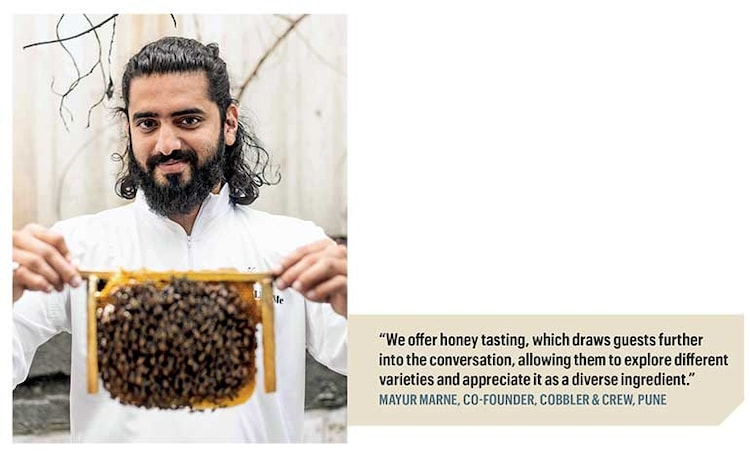
More than just an additive to sweeten cocktails, Cobbler & Crew—a bar in Pune—was the first to completely run on honey. Mayur Marne co-founded the place and claims honey’s superiority for its varied textures, sweetness levels, complexity, colour, and application, over sugars. He claims guests have never asked to replace honey with sugar in their drinks. “They’re receptive to the switch, appreciate the improved texture, and the opportunity to explore different kinds of honey. We offer honey tasting which draws the guests further in and makes them see it as a diverse ingredient”, he shares.

Cobbler & Crew, Pune, Mayur Marne of C & C, with a hive from their Bee Hotel Mayur Marne of Cobbler & Crew, Pune, with a hive from their Bee Hote

The utility of honey is a study by itself —- source of the honey, its moisture content, how it’s stored, how quickly it ferments, and lots more. The majority of our honey knowledge comes from bulk, supermarket brands. And trust me, most of what we know is incorrect. I was born allergic to honey, only to realise I’d been consuming fake bottled honey all my life. It was only after tasting pure honey, I realised I wasn’t allergic to honey but probably to the chemicals used in a majority of the big-label brands. Whatever we’ve been fed has been a result of what works for corporate giants. For instance, pure honey never crystallises; wrong, all types of honey does. It shouldn’t ferment on its own, incorrect, much like all sugars, it does spoil too. Wild hives in the park in front of your house, or in the back alley is consumable. Apparently, not. Honey doesn’t mix with water, yes it does, and that’s how all bars make honey syrup or honey water to add to cocktails. The darker the honey, the better it is; not really. You get the gist. Thus, the utility of honey, for a professional, solicits as detailed an understanding as do whiskies, agave spirits, or wines. Matmary concurs: “Different varieties of honey have different characters. Trigona honey is like a whisky—complex, dark, with very prominent flavour. Since it ferments in the hive it can even have a funky, kombucha-like flavour”. Who would have thought.

Just like various style of alcohols, decoding the styles of honey is imperative. It is as diverse an ingredient as any other. Rather than looking at honey as a loosely grouped term of nature’s favourite sugar, it should be the title of a book worth reading. For now, Nitin Vishwas, co-founder of Moonshine, Asia’s first meadery, shares the cheat-codes. “The type of honey decides the end result. Multifloral honey gives fairly neutral flavours. If you want a citrus twang, turn to Mustard honey, for caramel notes, Sidr works well, and for just a dash of sweetness, there’s Acacia. There are other types of honey too that can be complex and experiential such as the ones from the Sundarbans, Konkan belt, and Mahabaleshwar”, he explains.

What’s more, shares Matmary: “As compared to sugar, honey offers a lower Glycaemic Index (GI)—a measure of how quickly a food raises blood sugar levels compared to pure glucose—delaying your inebriation quotient, thus allowing you to hold your liquor for a longer time and hence drink more”. I’d drink to that.

ADVOCATING FOR BEES

While these bee-advocates have taken matters into their own hands and made it easier for you to participate in this bee-and-honey revolution. Here are some points to ponder: There are 350 types of bees, but only a couple of species make honey. The more urban we get, their habitat disappears. Hence, it becomes imperative to take care of them, which is why “Moonshine started the concept of ‘Bee Hotels’. We install bamboo pipes in societies with flowering plants, which allows a safe-haven for bees, allowing them to cross pollinate”, claims Vishwas. Cobbler & Crew homes a bee hotel too. “We’ve installed one in our outdoor section. It provides shelter for bees during extreme weather conditions and in exchange, engages guests to further the conversation and understanding around their habitat”, adds Marne.

Asia’s first, Moonshine Meadery, uses flavour bridges to make meads more acceptable

Bar Trigona goes a step further and actually encourages people to adopt a bee hive of their own. “We adopt a beehive, nurture and operate it for a year. Whatever is collected from that hive, we pack and store it for the guest to collect at the bar. It creates an emotional connect for them, for nurturing a living thing, and in turn, all the money goes to the farmer. We currently have 600 adopted hives, and that’s a lot!” claims Matmary.

In Bangkok, Anuman and his team bring people to the mountains, where they show them how honey is harvested. “It demonstrates to our guests how the environment and bees are in total sync. Our house project called the ‘Sanctuary Project’ provides a variety of stingless bee species (hives and boxes) to our edible flower suppliers/growers. In exchange for our bees pollinating her flowers, we get a chance to observe and learn about them at close quarters”, he shares.

Einstein once said ‘If the bee disappeared off the surface of the Earth, man would only have four years left to live’. If that’s the case, then it isn’t about cocktails, sustainability, price, a sweetener, or the texture of your cocktail. It’s about survival, doing the right thing for the environment, and for the next generation. And that’s a thought that you may want to raise a toast to.

https://www.indiatoday.in/magazine/supplements/spice/story/20250707-whats-in-my-drink-honey-2747057-2025-06-28

Sunday, 29 June 2025

Bristol, UK: New café where customers can buy bees and honey

From bbc.co.uk

A new café where customers can order bees or locally produced honey has opened.

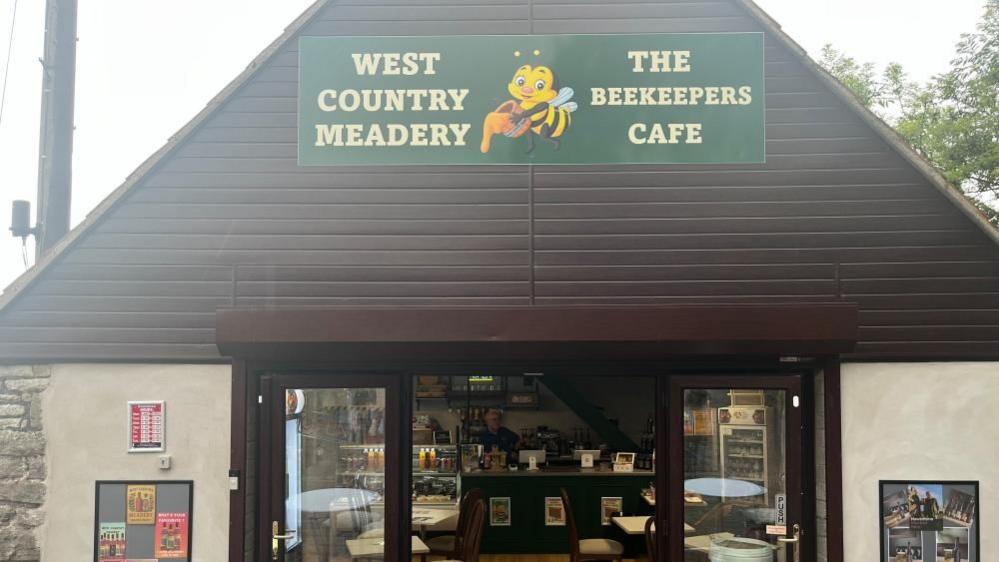
As well as coffee and cake, the Beekeepers Café in Redhill, Somerset, is selling all the equipment budding apiarists will need to manage their own hives - including the insects.

The café is part of West Country Meadery, which has been producing honey for eight years. Bosses hope the venture will provide a "really good" launchpad to those hoping to try their hand at keeping bees.

Exterior of the Beekeepers Cafe in Redhill, Bristol. Owner Rod Jenkins visible through open front doors.
Image caption,

The café provides a range of equipment to help people get started with Beekeeping

Owner Rod Jenkins said: "It's important to keep bees, especially for the environment, but it's also important that people do it properly. We don't want to spread diseases, so we teach people how to look after them properly."

West Country Meadery is the brainchild of husband and wife duo Rod and Tracey Jenkins.

They started their journey when Rod bought Tracey her first hive for Christmas in 2017.

She said the hobby "got a bit out of hand" and they now manage six apiaries across farmers fields, orchards and their own land.

As well as their own produce, the café sells books on beekeeping, suits and gloves.

Some of the products on offer in a display cabinet at the Beekeepers Café in Redhill, Bristol
Image caption,

Visitors can also get hands-on with Beekeeping experiences

Rod and Tracey also want to give aspiring keepers the chance to get "hands-on" by offering experience vouchers.

Between May and August, people can visit the café, get suited up and head to an apiary to lend a hand with inspections and 'hive smoking,' a practice used to keep bees calm.

The café will then offer visitors the chance to buy their own bees and hive.

https://west-country-meadery.com/

https://www.bbc.co.uk/news/articles/cdr5pzd817ro 

Saturday, 12 April 2025

“Tell It To the Bees” And More Honey Bee Legends

From farmersalmanac.com

Ever hear the expression “tell it to the bees?” Learn what it means, as well as other interesting lore and legends about honey bees

Honey Bee Lore and Legends 


The value of honey bees has been recognized for millennia. In ancient Egypt, bees were believed to have been formed from the tears of the sun god, Ra, to bring his messages to earth. Likewise, in ancient Greece and Rome, bees were seen as messengers of the gods. Ancient Chinese and Celtic civilizations considered honey as a sacred gift that helped the dead in the afterlife.

Tell It to the Bees

The ancient practice of “telling it to the bees” is still popular in both western Europe and Appalachia in the United States. Bees are such a valuable resource to support a family, so people in these areas feel that they should be treated with the same respect of family, especially when there are major changes.

For example, when a beekeeper dies, the bees must be gently told of the change of family leadership (as the keeper is the head of the “family” hive). If not, the bees may abandon the hive and family, or mourn so deeply that their productivity will be dramatically reduced.

Sing, Don’t Swear 

Beekeeping lore insists on always treating a hive with respect and gentleness. Singing to the hive is even encouraged to improve bees’ productivity.  

Bees are believed to be sensitive creatures. Many believe that their productivity can be impacted if they hear swearing or arguments.

Honeymoon  

The word “honeymoon” is believed to originate with a Scandinavian tradition of giving a newly married couple a month’s worth of “honey wine” or mead (a fermented honey drink). This gift would celebrate the sweetness of new marriage and encourage happiness.


More Bee Lore 

  • If a bee flies into your house, you will have a visitor. However, be sure to keep it safe or the visitor may bring bad news. 
  • If a bee lands on your hand or head, you will receive a reward soon.
  • Ancient Greeks believed that if a bee landed on a baby’s lips, that baby would turn out to be a great speaker.   
  • Romans believe that Jupiter gave bees their stingers so they could defend their honey. It’s also believed to repay Jupiter for this ability, honey bees would have to die when they sting you.

Keep the Legends Alive 

With so much wonderful lore associated with bees, what can we do to better protect bees today?

  • Minimize chemical use, including fertilizers, pesticides, and herbicides, can help prevent toxic contamination that kills bees.
  • Plant a bee garden with flowers rich in nectar and pollen. This will give bees a refuge, and adding a shallow “bee bath” as a water source is a great step.
  • Don’t mow patches of your lawn to give honey bees places to nest to encourage the next generation.
  • Buy local honey and bee-related products to support the next generation of beekeepers, keeping local hives thriving.

What Bees Give Us

Honey bees are essential to our ecosystem. There are more than 16,000 species of bees in the world. They are found on every continent except Antarctica. Bees pollinate beautiful flowers as well as a wide range of fruits and vegetables, from apples, blueberries, and cherries, to avocados, pumpkins, coffee, mangos, and more.

Bee venom is often used in homeopathic or alternative remedies* for its anti-inflammatory properties, and beeswax is used for candles and soap. *Note: Farmers’ Almanac does not offer medical advice. Information contained here is for educational purposes only.

Beekeeping has been a skilled profession since ancient Rome and Egypt and continues today. From both bee-related products to the greater agricultural yields that come with more pollination, bees are estimated to contribute $19 billion to the U.S. economy annually, and more than $217 billion to the worldwide economy. 

With so many positive impacts from bees, it is no wonder that these industrious insects have been part of our lore, superstitions, and cultural beliefs for centuries.

https://www.farmersalmanac.com/honey-bee-legends

Tuesday, 4 March 2025

Virginia USA: A Meading Of The Minds

From styleweekly.com

By Rachel Kester

Sip on the nectar of the gods at these two RVA meaderies 

It might be one of the world’s oldest alcoholic beverages, but mead (or honey wine) is widely overlooked in a world focused on beer, wine and spirits. Crafted with honey, yeast, water and whatever infusions strike a mead maker’s fancy, this drink marches to its own drum despite often being pushed into the shadows.

In Virginia, there are only about a dozen meaderies—a stark contrast to its over 300 wineries and 200 craft breweries. Richmond is home to two of these meaderies, each with distinct styles but the same mission: To spread an appreciation for the nectar of the gods.

Funktastic Meads & Beer

Tucked in Midlothian’s Alverser Plaza, this suburban meadery has been pouring some of the wildest mead flavours imaginable since opening in 2022. Where else can you order a mug of Sweetish Fish, a play on the popular candy?

“Making mead is very similar to traditional grape wines,” says owner Matt Carroll. “We use honey, water and yeast as a basis for all meads we make and then, us in particular, do crazy stuff to it.” Carroll, who has a chemistry background, infuses batches with everything from fruits and spices to hot peppers and coffee beans.

                                                                                     Funktastic owner Matt Carroll

While traditional mead is available, Funktastic also creates carbonated, pure fruit and cocktail-inspired options. Their flavours hit on nostalgia and are full of intriguing twists. One of their most popular selections is the fizzy F&M Root Beer, an ode to the classic soda.

Funktastic uses about 12,000 pounds of honey yearly—primarily wildflower—but other varieties will sometimes show up, like meadowfoam. This honey naturally tastes like a fresh vanilla-infused marshmallow and is featured in their Marshmallow Eyes.

Carroll is constantly experimenting and has over 200 recipes with 25 meads currently available on tap, although these rotate monthly with about three regularly available.

Black Heath Meadery

Take a drive from the ‘burbs to Scott’s Addition and you’ll find Bill Cavender making mead at Black Heath Meadery.

Black Heath was the first of its kind in the city when it opened in 2015, but Cavender’s passion for the drink slowly ignited about three decades ago after returning home from a semester abroad in England.

“I had really fallen in love with a lot of European beer styles and from there came home making beer and I kind of moved over to honey wine,” he says. Mead making was a hobby for about two decades before it became his primary job.

                                               Black Heath Meadery’s owner, Bill Cavender with office mascot Otis

“[My wife and I] started the RVA Mead Lab and ran that for about a year,” he says. “[The lab] was to explain mead to people and engage people in mead making.” Black Heath Meadery came to fruition soon after.

One of Cavender’s biggest focuses is incorporating local ingredients in his meads, especially fruit. The meadery partners with area farms like Swift Creek Berry Farm and Agriberry for fresh blackberries, raspberries, blueberries and strawberries. These can be found in batches like the award-winning Berry Goode, Red Razz and Bramble Bee.

                                                 Black Heath’s award-winning Berry Goode, Red Razz and Bramble Bee

As a beekeeper, Cavender produces the majority of his own honey with hives scattered throughout the commonwealth. Over 3,000 pounds of honey from the hives is used toward their mead.

Black Heath currently offers 12 meads on draft with about 18 in to-go bottles, including the popular Demon Sweat, a hibiscus and cinnamon blend.

You can also find Black Heath mead in local restaurants and bars that use their concoctions in cocktails, including Bar Solita, who makes their Velvet Lechance with cabernet franc, Black Heath’s blackberry mead, port wine, Spanish vermouth, mulling spices and orange.

If you’re unable to visit the meadery, Black Heath is often at local events, including the upcoming Richmond Renaissance Faire on March 7.

As this year marks a milestone birthday for the business, starting March 15, Black Heath will throw a 10-year anniversary, 10-week long bash. The kickoff party will feature Thai soul food from pop-up Eat Boi! and they’ll also debut a green mead for their small batch Spectrum series which features fruit meads with no water added.

Plight of the honey bee

While it has been around for centuries, mead is still strange to some, one of the biggest challenges for meaderies. It’s why Funktastic added beer to their menu last April. “[There were] people coming in for beer but once they got here they made their way into mead,” says Carroll.

Because mead is honey-based, the plight of the honey bee is also a concern. The insect faces numerous obstacles due to climate change and toxic chemicals which can affect honey quantities.

Despite this, Cavender feels mead provides the perfect learning opportunity. “People are more aware on a larger scale,” he says regarding the honey bee’s significance. “It’s not just honey but all these wonderful foods bees pollinate. Mead has kind of helped educate people on how important the honey bee is.”

                                                                           The exterior of Black Heath Meadery

Mead is believed to have origins in Africa and has been used over the centuries across societies as an offering, medicine and even a good luck charm.

Unlike traditional wine, mead is more resistant to oxidation and spoilage. Its notes also progressively evolve, something evident in Funktastic’s High Tide, a mixture of black currant and vanilla.

“When it’s fresh, the vanilla is really present and pops,” says Carroll. “But over time, it homogenizes into a black currant flavour.”

While made of sweet honey, mead can be savoury or dry, feature up to 20% ABV or go as low as 7% ABV, be aged in bourbon barrels—there’s really no limit to what can be done.

But perhaps for some, what makes mead so spectacular isn’t just how the drink defies expectations but how it uniquely links the world.

“I feel mead is an important cultural and social connection for people,” says Cavender. “Pretty much every society in the world has consumed [mead] in their history. It serves as a touch point for people to find commonality.”

https://www.styleweekly.com/a-meading-of-the-minds/