Thursday, 24 April 2025

Reviving mead in Kinsale after 200 years

From corkindependent.com

The lost art of mead making has been resurrected in Cork thanks to Kate and Denis Dempsey.

Kinsale Mead is Ireland’s first meadery in 200 years and and is located a short walk from the town centre in Kinsale.

If you’re curious about this drink of our Celtic kings and chieftains, then a tour of the meadery is a real treat. Mead, often referred to as honey wine is fermented from 100% pure honey, 12% ABV and a great Irish alternative to wine. The tour is a fun entertaining mix of myths and legends of mead, honey tasting, mead making and tasting.

Relive some of the tales of St Gobnait the patron saint of bees in Ireland, who used her bees to defeat raiders from Kerry who came to steal her honey in Ballyvourney.

Do you know about the connection between the McCarthy Cup and our ancient mead drinking cups known as methers? Have you heard about our ancient bee laws – the Bechbretha from the seventh century when bees were more protected than they are today?

                                                                            Kate & Denis Dempey, owners of Kinsale Mead


You’ll get a chance to taste some of the unique real raw honey we have in Ireland as well as further afield that are used in the mead making. Learn about honey bees and wild bees and why we must do all we can to support pollination friendly practises.

Find out how mead is produced in Kinsale as you tour the meadery and of course the highlight; taste a selection of the amazing meads. Their newly released Miskey meads are a meeting of West Cork and East Cork – Dark Forest Honey Mead from Kinsale aged in whiskey casks from Midleton distillery, a real sensory treat. Overall, it’s a must visit on your next day out in Kinsale.

https://www.corkindependent.com/2025/04/23/reviving-mead-in-kinsale-after-200-years/ 

Wednesday, 23 April 2025

UK: Honey, wake up - mead abuzz with a new lease of life

From thedrinksbusiness.com

Forget everything you thought you knew about mead — Gosnells is rewriting the rules. Light, sparkling and refreshingly modern, it’s a bold new take on an ancient drink, writes Declan Ryder 

Most of us know mead as the forgotten medieval tipple that faded into complete insignificance centuries ago. It is discussed in conversation much in the same light as other now obsolete relics like trebuchets and chamber pots. Though once relegated to obscurity around the Renaissance, mead has enjoyed a mini renaissance of its own in the past 10-20 years, moving out of the history books and back onto the palettes. 

The mead industry was declared the fastest-growing drinks category in the US in 2017. There are now around 250 meaderies across the pond – a figure that only increases year on year. And globally, the appetite is increasing too: Fortune Business Insights projects the global market to grow from US$591.5 million in 2024 to US$1,395.7 million by 2032, at an annual growth rate of 11.33%.

But while many hail this as a great revival, Tom Gosnell, founder of one of the UK’s leading meaderies, sees things very differently.

“I haven’t seen a resurgence of mead, at least in the UK,” he says. “There’s not that many producers, and they’re all quite small.”

This is the tension at the heart of mead’s modern moment: it may be the world’s oldest alcoholic drink, but its future may depend on forgetting its past.


Rebranding mead for a new generation

Gosnell started making mead from his London kitchen in 2014. Now, over a decade later, he runs one of the biggest mead brands in the country. In March of last year, they opted to rebrand from ‘mead’ to ‘nectar’, sensing that the very term mead was proving a buzzkill to prospective customers. 

“Calling it ‘mead’ was only holding us back, to be honest,” Gosnell says. “Our rate of sale went through the roof immediately [after the rebrand].”

He believes if there is to be any true resurgence in mead drinking, it means veering away from its historic connotations, rather than into them. Rather than tailoring their target market to history buffs like many of their competitors, their focus lies solely on the drink and aims to appeal to those who don’t like beer but still want to drink a pint. 

“We wanted to talk about the liquid and the natural side of things,” Gosnell says. “We’ve always done this session style of mead called nectar, which is much more approachable and easy to drink.”

Bringing mead to the people

To truly give their nectar a voice, Gosnells are preparing for a big sampling campaign in the summer, with 15-20 pop-up bars throughout London. The company will supply the venues with kegs at wholesale prices, handling the staffing and sampling themselves. It’s a tactical move aimed at converting the curious who might not have yet thought of mead as a drink for today.

“We believe as a team that good brands are built in the on-trade rather than the off-trade. That’s where you go for new experiences,” he says. 

Yet despite Gosnells’ bold steps towards a contemporary identity, mead’s history is rich, spanning millennia and leaving behind a legacy that’s far from forgotten. Widely regarded as the world’s oldest alcoholic beverage, mead is believed to have been discovered as long ago as 20,000 BC in Africa through the natural fermentation of honey and rainwater. The first tangible proof of its existence dates from around 7000 BC, with archaeologists having found traces in ancient Chinese pottery vessels. Throughout the following millennia, it was a favourite drink of the ancient Egyptians, Romans and Greeks, lauded by the latter as “the nectar of the Gods”. 

The Viking myth and monastic reality

It is now mainly affiliated with the Vikings, conjuring images of six-foot-something hairy behemoths chugging tankards of the stuff with wild abandon. While the Vikings were indeed partial to the beverage, this is a rather reductive picture. Mead played a vital role in the economy of several societies. Monasteries across Europe brewed mead both as a source of income and for medicinal purposes, believing in its health-giving properties. The term “honeymoon” comes from the medieval tradition of drinking honey wine for a month after marriage, as it was believed to ensure fertility – a practice taken so seriously that a bride’s father often included a month’s worth of mead in her dowry.

So, what actually is mead? Essentially, it’s a honey wine – made by fermenting water with honey. As Will Grubelnik from Gosnell’s puts it, “As apples are to cider, grapes are to wine, honey is to mead”. In its purest form, it is a very simple production process, which explains why its history is quite so old. 

A drink of endless variety

Types of honey (and therefore mead) vary wildly depending on the bees’ diet of nectar and pollen. Traditional meads use milder honeys like clover or orange blossom, stronger honeys like buckwheat or wildflower add bold flavours, perfect for spiced varieties. The detailed recipes and methods developed by medieval monastic communities contributed significantly to the refinement and diversification of mead over the centuries, leading to the creation of various styles, including melomels (fruit meads), metheglins (spiced meads), and cyser (apple meads). 

It is this potential for diversification that is driving the drink’s contemporary appeal. Its possible flavour profiles, from sweet and fruity, to earthy and spicy, alongside the fact that it can be produced either still or sparkling, appeal to a wide range of palettes. Gosnells, for instance, offers both still and sparkling meads and utilises various honeys. Their flavour options include a fruity raspberry and hibiscus, which drinks much like a fruit cider and a wonderfully unconventional ‘blueberry velvet’ option (which the bar manager aptly describes as something between a Guinness and a Müller Corner).

Generation curious

The revival also sits as part of a broader drinks industry growth towards craft beverages. Consumers are seeking unique and artisanal products crafted with a real sense of provenance, and mead fulfils all of these criteria. 

For a drink that wrestles so fiercely with its past, it now faces a future that demands reinvention over reverence. Mead may have once been nectar of the gods, but today it’s shaping up to be something altogether more modern. 

https://www.thedrinksbusiness.com/2025/04/honey-wake-up-mead-abuzz-with-a-new-lease-of-life/

Saturday, 19 April 2025

UK: Oldest alcoholic beverage thrives in Wrexham thanks to local company

From wrexham.com/news

The oldest alcoholic drink known to man has found a home in Wrexham.

Tony Cornish, an experienced mead-maker, has been crafting mead since the early 1990s.

He operates at his his meadery, Stone Circle Mead Company, on Rhosnesni Lane.

The business specialises in producing traditional, oak-aged meads blending Welsh honey, spices, foraged fruits, nuts, flowers and herbs.


From their Wrexham premises they supply some prestigious locations in the UK, including the House of Commons, the Senedd and various National Trust properties as well as offering tasting tours where you can try, buy, and learn about mead and its production process.

Cllr Nigel Williams, lead member for economy, business and tourism, said: “This is a unique business in Wrexham and another example of investment in the county borough.

“Tony has received support from the council’s business and investment team to help him maximise on business opportunities and I wish him all the luck for the future.”

Tony Cornish, owner of Stone Circle Meads Company, said: “We were delighted to meet Cllr Nigel Williams at the meadery recently.

“He spent a good deal of time with us to hear about what we do and the exciting plans we have for the future.”

https://wrexham.com/news/oldest-alcoholic-beverage-thrives-in-wrexham-thanks-to-local-company-268909.html 

Washington: An Idyllic Farm and Meadery that Takes Being Chill Seriously

From seattlemet.com/travel-and-outdoors

Port Townsend’s Wilderbee Farm is a rural escape with a craft beverage bonus 

“It’s so relaxing,” I hear a patron say.  We’re inside the tasting room at Wilderbee Farm, overlooking an orchard of budding fruit trees, each with a glass of mead in hand.

The Mead Werks tasting room has cosy wood accents, making it feel like a mountain lodge inside a farmhouse. I can spy the honey boxes across the lawn, where the bees are working hard. They’re the only ones here who don’t seem at ease.

Mead is having a bit of a moment. The lightly sweet wine-like drink has been buoyed by growing interest in niche craft beverages, with most makers leaning into its historic renaissance faire associations: Tukwila’s Oppegaard Meadery is all about the Viking vibe, while and Mr. B’s Meadery in Fremont embraces the drink’s whimsical reputation as magical alchemy.  At Wilderbee, a few miles west from downtown Port Townsend, mead is the star of something more earthy.

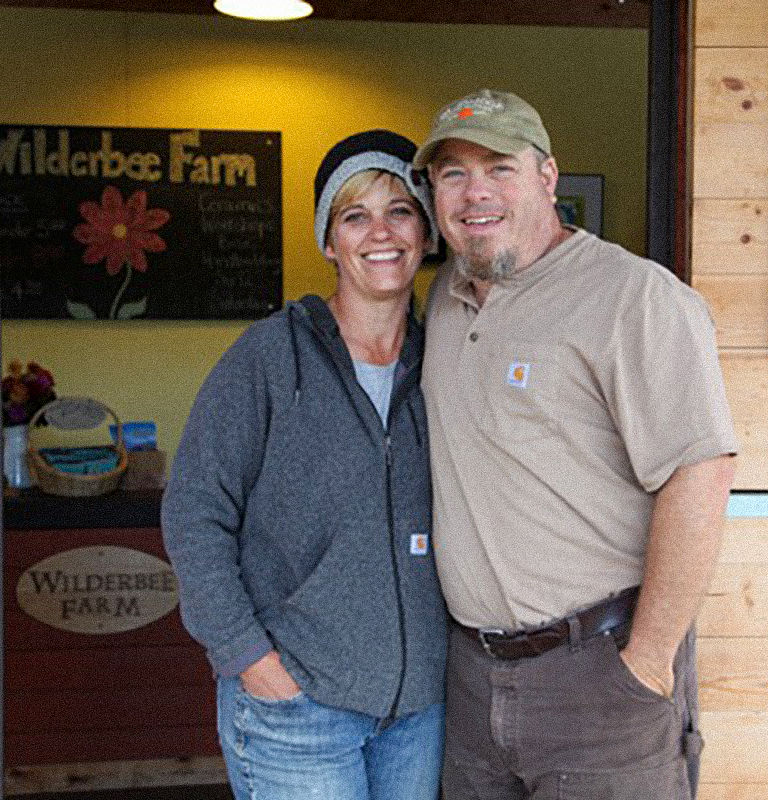
Casey and Eric Reeter.

Casey and Eric Reeter set out to create a place that felt calm and laid back—eventually. Their dream was to build a rural escape in retirement, inspired by farms in North Bend and Monroe they used as quick respites from their West Seattle life. But when they found the perfect 12-acre spot earlier than expected, they moved to Port Townsend in 2007.

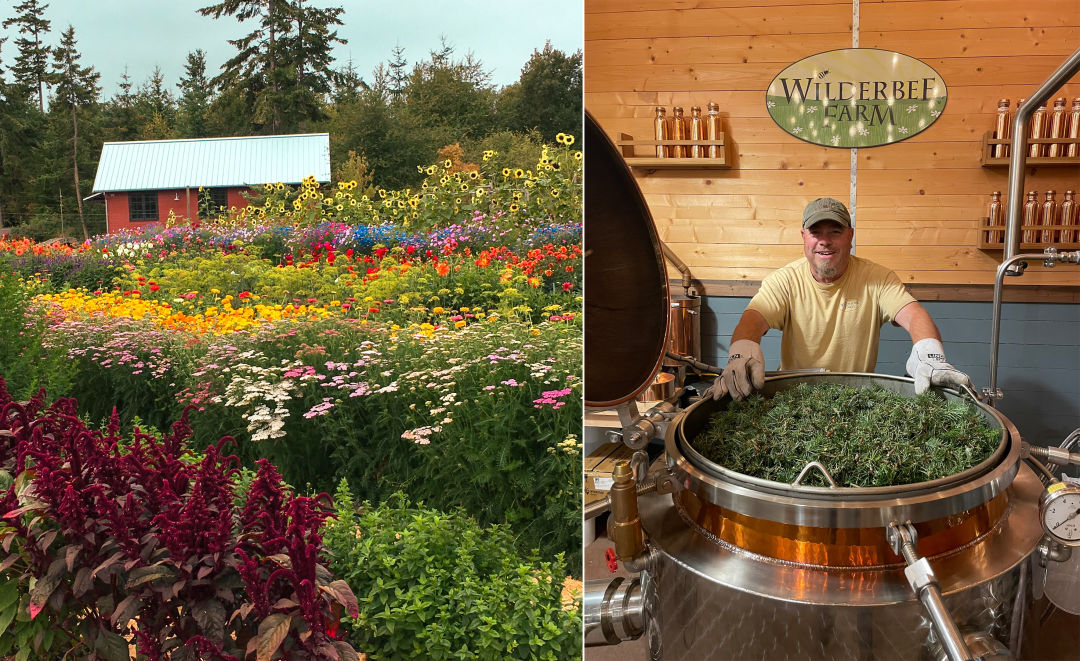
Today the acreage is a working farm, complete with certified organic U-pick flower fields and pumpkin patch, and a herd of rare British Soay sheep known for their small size. In fall, their fine wool is hand-plucked. Visitors can easily fill half a day between feeding the animals, working in the ceramics studio, wandering nature trails crisscrossing the property, and sipping mead.

Owning and working the 12 acres is a far cry from retirement, but “it doesn’t feel like work,” Casey says before setting off to plant flower seeds in the greenhouse. In summer, dahlias, zinnias, and sunflowers sprout into a rainbow of U-pick options, the $9 DIY bouquets of 25 stems each putting even Pike Place Market’s best to shame.

The addition of a meadery in 2019 to make use of Wilderbee’s flower fields just made sense. The craft beverage industry was skyrocketing—there are three cideries within 10 miles of Wilderbee—and the Reeters felt their flowers could serve double duty. They had been beekeepers for years and knew honey. At first, their pantry became a micro meadery for home brewing experiments. They took a mead course at Ballard’s National Nordic Museum, then another at UC Davis. Eventually they went commercial.

The tasting room boasts a menu of 14 meads alongside table games and local art. String lights hang from wooden rafters just below a tin roof, and at first glance this could be an unbuttoned wine tasting room or woodsy brewery. But here the bees always get top billing; the bar’s honeycomb tilework matches the tasting room’s brass bee-shaped door knocker.

Meads arrive in four-ounce pours, three-variety flights, or whole bottles. Casey’s dream flight: First, the Larryberry sparkling blueberry mead named after her dad, Larry. The fizzy, cherry red pour is crisp and fruity, nothing like my expectations of straight honey or something like kombucha. Next, the Nectarious After Dark Bourbon, which Casey calls a sweet mead. “We put it in bourbon barrels for years—anywhere from three to five years—and it has all these caramelly toasted marshmallow notes,” she says.

And finally, a seasonal release; in spring it’s a mango-infused dry variety, but the menu constantly incorporates bold flavours like apples, chai, and even smoked peppers. Spiced mead served warm will debut on the autumn equinox. 

Casey calls her husband and herself “makers” above all. The ceramics studio hosts workshops in the summer and her father sells woodcrafts like display-ready charcuterie boards and whimsical birdhouses in the gift shop. They sit on shelves along with copper-distilled lavender essential oils and balms crafted from the farm’s yield.

So maybe the owners themselves are as busy as the bees outside. For everyone else, Wilderbee serves the farm’s mission, at least as Casey puts it: “to have people come here and just relax and escape the stress of their world and leave happy.”

https://www.seattlemet.com/travel-and-outdoors/2025/04/wilderbee-farm-meadery-day-trip

Wednesday, 16 April 2025

USA: Virginians craft an ancient beverage - mead

From starexponent.com

NELLYSFORD — One of humanity’s oldest libations is making a comeback in Virginia.

With roots dating to at least 7,000 B.C. in China, mead fell out of favour when beer and wine took centre stage. However, the American Mead Association reports there are around 450 commercial meaderies in the U.S., with more opening as the fermented honey drink experiences a revival.

In Nelson County, Hill Top Winery & Meadery is among local crafters bringing ancient traditions back to life. What began as a you-pick berry farm in 1993 has grown into a popular spot offering over 20 meads.

“My dad made the first batch, and I saw all the possibilities,” reflected Kimberly Allen-Pugh, who owns the business with her husband, Gregory. “Making mead combines my love of history and the ability to be creative.”

She describes mead as “history in a bottle,” and visitors to Hill Top’s medieval-themed tasting room can sample varieties ranging from dry to sweet, including a traditional Viking-style mead and Gladius, a pyment made by fermenting honey and grape juice. The meadery sources honey from local and international apiaries while incorporating local flavours from foraged pawpaws, wild persimmons and mulberries.

Bottling in small batches year-round, Hill Top sells both online and in the tasting room — drawing customers from across the globe.

“When we first started, most people did not know what mead was or might say, ‘Oh I had that in Ireland,’” Allen-Pugh said. “Now more people are familiar, there are more meaderies in existence, and we have a product that’s sought out.”

                                                                  Doug Suchan (left) and John Kluge (right). VIRGINIA FARM BUREAU

Situated outside of Charlottesville, Thistlerock Mead Co. has built a sustainable ecosystem around the drink — from flower to bottle. Founded in 2022 by John Kluge Jr. and Doug Suchan, the operation’s 70 beehives and millions of bees produce much of its honey.

“At least 51% of all the honey we use is sourced from our hives,” explained Allison Wickham, Thistlerock’s director of apiary operations.

Blending their honey with sustainably sourced varieties from Colombia, Ethiopia and other regions, “the different flavours of honey carry through the mead,” Wickham said. “Just like chardonnay and merlot grapes make dramatically different wines, similarly, buckwheat honey and acacia honey make meads with different colours and flavours.”

Chief mead maker Suchan explained 3 to 4 pounds of honey produce a gallon of mead, which is fermented in steel tanks and aged in oak barrels. Thistlerock’s lineup includes a semi-dry variety with notes of pear and honeycomb and a semisweet mead infused with Ethiopian coffee beans and vanilla.

As its popularity grows, Thistlerock works to elevate mead’s presence. Kluge is collaborating with local meaderies to begin a state mead association, the Virginia Mead Guild, which received a grant to develop a Virginia Mead Tasting Trail.

“We want people to be able to go into their local shop or favorite restaurant and order mead,” Kluge said.

And with over 25 commercial meaderies in the state, “I think Virginia is well positioned to do that.”

https://starexponent.com/news/state-regional/article_d5c9142f-aadb-47fb-b179-7d0eb192c432.html 

Saturday, 12 April 2025

“Tell It To the Bees” And More Honey Bee Legends

From farmersalmanac.com

Ever hear the expression “tell it to the bees?” Learn what it means, as well as other interesting lore and legends about honey bees

Honey Bee Lore and Legends 


The value of honey bees has been recognized for millennia. In ancient Egypt, bees were believed to have been formed from the tears of the sun god, Ra, to bring his messages to earth. Likewise, in ancient Greece and Rome, bees were seen as messengers of the gods. Ancient Chinese and Celtic civilizations considered honey as a sacred gift that helped the dead in the afterlife.

Tell It to the Bees

The ancient practice of “telling it to the bees” is still popular in both western Europe and Appalachia in the United States. Bees are such a valuable resource to support a family, so people in these areas feel that they should be treated with the same respect of family, especially when there are major changes.

For example, when a beekeeper dies, the bees must be gently told of the change of family leadership (as the keeper is the head of the “family” hive). If not, the bees may abandon the hive and family, or mourn so deeply that their productivity will be dramatically reduced.

Sing, Don’t Swear 

Beekeeping lore insists on always treating a hive with respect and gentleness. Singing to the hive is even encouraged to improve bees’ productivity.  

Bees are believed to be sensitive creatures. Many believe that their productivity can be impacted if they hear swearing or arguments.

Honeymoon  

The word “honeymoon” is believed to originate with a Scandinavian tradition of giving a newly married couple a month’s worth of “honey wine” or mead (a fermented honey drink). This gift would celebrate the sweetness of new marriage and encourage happiness.


More Bee Lore 

  • If a bee flies into your house, you will have a visitor. However, be sure to keep it safe or the visitor may bring bad news. 
  • If a bee lands on your hand or head, you will receive a reward soon.
  • Ancient Greeks believed that if a bee landed on a baby’s lips, that baby would turn out to be a great speaker.   
  • Romans believe that Jupiter gave bees their stingers so they could defend their honey. It’s also believed to repay Jupiter for this ability, honey bees would have to die when they sting you.

Keep the Legends Alive 

With so much wonderful lore associated with bees, what can we do to better protect bees today?

  • Minimize chemical use, including fertilizers, pesticides, and herbicides, can help prevent toxic contamination that kills bees.
  • Plant a bee garden with flowers rich in nectar and pollen. This will give bees a refuge, and adding a shallow “bee bath” as a water source is a great step.
  • Don’t mow patches of your lawn to give honey bees places to nest to encourage the next generation.
  • Buy local honey and bee-related products to support the next generation of beekeepers, keeping local hives thriving.

What Bees Give Us

Honey bees are essential to our ecosystem. There are more than 16,000 species of bees in the world. They are found on every continent except Antarctica. Bees pollinate beautiful flowers as well as a wide range of fruits and vegetables, from apples, blueberries, and cherries, to avocados, pumpkins, coffee, mangos, and more.

Bee venom is often used in homeopathic or alternative remedies* for its anti-inflammatory properties, and beeswax is used for candles and soap. *Note: Farmers’ Almanac does not offer medical advice. Information contained here is for educational purposes only.

Beekeeping has been a skilled profession since ancient Rome and Egypt and continues today. From both bee-related products to the greater agricultural yields that come with more pollination, bees are estimated to contribute $19 billion to the U.S. economy annually, and more than $217 billion to the worldwide economy. 

With so many positive impacts from bees, it is no wonder that these industrious insects have been part of our lore, superstitions, and cultural beliefs for centuries.

https://www.farmersalmanac.com/honey-bee-legends