Sunday, 18 September 2022

Try Mead this weekend. The ancient honey-based fermented alcohol is making a comeback in India

From businesstoday.in

Mead, an ancient honey-based fermented alcohol that is flavoured with natural fruits and spices, is making a comeback in India thanks to a handful of enthusiastic alcobev buffs


Quick, what's common between Lord of the Rings, Harry Potter and the Vikings? It’s mead (rhymes with need), an ancient honey-based fermented alcohol that’s slowly making a comeback in India with a handful of players producing it. “Mead is not beer,” says 38-year-old Rohan Rehani, Co-founder of Pune-based Moonshine Meadery­—the very first meadery in India that started production in 2018.

Rehani and childhood friend Nitin Vishwas (38) read about mead in 2014 in an article that talked about how London was getting its first meadery in 500 years. Having only read about meads in Lord of the Rings (Gandalf takes swigs of it) and Harry Potter (Hagrid orders four pints at the Three Broomsticks Pub in Hogsmeade), they had thought of mead as something mythical that had been lost to time. “We were fascinated. Mead is probably the first known alcohol. It finds a mention in 7000 BC in Chinese pottery. The Vikings drank it before going into battle. Mead was also a part of ancient Indian culture. The word mead comes from the Old English word ‘medu’ that comes from ‘madhu,’ which is honey and then there is ‘madhushala,’ which is a place where you drink alcohol,” says Rehani.

Both Rehani and Vishwas are engineers by education and had corporate careers. In 2016, Rehani quit his job to make mead full time. What started as a kitchen experiment finally moved to a proper plant on the outskirts of Pune. However, since mead had not been made in India before, there was no provision for it in the excise law. “You could brew beer and ferment grapes to make wine but you could not ferment honey,” says Rehani.

Rehani and Vishwas decided to meet the excise minister of Maharashtra to change the excise law and get a licence.

Meanwhile, Yoginee Budhkar (39) and Ashwini Deore (39), two friends who completed their PhD in biotechnology and bioprocess technology, respectively, from Mumbai, also decided to make mead. After almost a year of trying, all four finally met the excise minister. “It was difficult to meet him but once we did, he was very open to the idea of us making mead and we got clearance instantly,” says Budhkar.

While Moonshine hit the market in 2018, Cerana (named after the Indian honey bee) started producing mead in 2020.

                   No Label, a brand of Bored Beverages, has raised Rs 2.5 crore in seed funding


Currently, Moonshine produces two types of meads: the year-round flagship meads, such as Apple Cyder, Coffee, and Traditional, and a MeadLABs series, which comprises small-batch, experimental, and seasonal meads. Salted Kokum, Grilled Pineapple, which is Rehani’s favorite, Guava Chilli, Hopped Mead, Thai Ginger, and Kaffir Lime, all at 6.5 per cent alcohol by volume (ABV) are the best-selling items under the MeadLABs series. Moonshine is available in Karnataka, Goa, Maharashtra, Assam, Rajasthan and Silvassa, and is priced at Rs 140-250 for 330ml. Production has gone up from 200 cases in the first year to 5,000 cases a month today, and they plan to expand capacity to 3x by the end of the year. “Mead is made with all natural ingredients, with honey being the most important. We now control our supply of honey to ensure we have the best quality,” says Rehani.

Nashik-based Cerana has a focus on local flavours. For its main meads, which include the Jamun Melomel, Pomegranate Melomel, and Chenin Blanc Pyment, priced at Rs 180 for 330ml, it procures the jamuns, pomegranates and grapes locally. Its limited-edition seasonal meads, which include varieties like Yule Spice (made with honey and spices) and Pinot Noir Pyment (made with honey and grapes), typically have a higher ABV of 12 per cent and are priced at Rs 450 for 375 ml. Currently, Cerana is available in only Mumbai, Nashik and Pune. But it is planning on increasing production and will soon be available in Bengaluru and Goa.

               Stump, Karnataka’s first mead, is available in two flavours— coffee and apple cider


Childhood friends Anant Gupta (26) and Vinayak Malhotra (27) are fascinated with all things alcohol. They discovered mead on their travels abroad and thought there was a market for it in India. “We saw this wide space in India in the alcobev sector. The younger generation was looking for something more flavourful in the ready-to-drink segment,” says Gupta, Co-founder of Bored Beverages. Initially they thought they would make wine. “Our idea was to simplify wine. Right now in India wine is considered so fancy that most consumers run away from it,” says Gupta. However, they realised that not only was making wine a very expensive proposition, it was also seasonal, and that they would have to depend on someone else to make it. Mead, on the other hand, could be made the whole year round, had a long shelf life, one could play with flavours and, most importantly, Gupta could learn to make it. Their brand No Label with 7 per cent ABV was launched in November 2021 and is currently available in Delhi, Gurugram, Mumbai and Pune, priced at Rs 150. They produce nearly 1,700 cases a month. Currently, they have only one flavour and will launch another by the end of the year. They have recently raised Rs 2.5 crore in seed funding from Inflection Point Ventures and other private investors.

Like wine, meads come in a variety of rich to sweet flavours and can be either still or effervescent. India’s mead producers are hard at work developing new varieties of their product to suit the tastes of their customers. Take, for example, Stump, Karnataka’s first mead, which is available in two flavours—coffee and apple cider. Founded by Himavanth Hasaganur Jayanth (26), Chandrakanth (33) and Thejaswi (43) in February this year, their coffee mead has an ABV of 8.5 per cent (Rs 180) while the apple is lighter with 6.5 per cent ABV (Rs 160). Currently available only in Karnataka, they plan to increase production to 10x by November and then target Goa, Maharashtra and Hyderabad. Jayanth has a coffee plantation and the coffee comes from there.

Arkä from Maharashtra-based Hill Zill Wines produces three high-quality dessert meads: Wildflower, Rose, and Jamun. The meads are packaged in ice wine bottles and specialised corks to aid in the ageing process and are made using local and fresh ingredients such as honey obtained from wild flowers, dried rose petals, and Konkan jamuns. The meads are available in Maharashtra, Goa, Arunachal Pradesh and Karnataka. They are priced at Rs 1,075 for a 375 ml bottle.

While mead is still a small market in India with the producers spending a lot of time educating customers about it, it is a growing market globally. The global mead beverage market is projected to grow from $487.9 million in 2021 to $1.62 billion in 2028 at a CAGR of 18.71 per cent between 2021 and 2028, says a report from Fortune Business Insights, a market research firm. It’s time to raise a toast to mead. 


Thursday, 1 September 2022

Mead We Say More: The Entrepreneurs Promoting The Real African Drink

From forbesafrica.com 

Producing and retailing mead, Ernst Thompson and Robert Bernatzeder aim to establish it as a mainstream alcoholic beverage in African society and tell its story on the continent

MEAD IS THE FIRST ALCOHOLIC DRINK connected to humans and is thought to have originated in Africa some 20,000 years ago, but along with the Vikings and other medieval marauders has largely been surpassed by modern equivalents. That is until now.

Made from fermented honey, mead is growing in popularity again thanks in a large part to the television series Game of Thrones and the throngs of its followers who lap up every detail of the show to replicate in their daily lives.

“Many people in South Africa don’t know what mead is, despite the fact it is a real African drink,” Dr Ernst Thompson, owner of Cape Town Meadery, tells FORBES AFRICA.

“It is massive in the United States. Popular culture has commercialized it there over the last 10 or 12 years and it is the fastest-growing alcoholic sector.”

In South Africa, mead was a way for the Khoisan people to ‘speak to the Gods’ and is known as iQhilika in the country’s Eastern Cape province, where it remains a popular drink with cultural significance.

But it is a tiny market in what is a huge beverage industry in the country, something Thompson is hoping to change having partnered with brother-in-law and fellow entrepreneur Robert Bernatzeder.

Their meadery, the only one of its kind in South Africa, bottles traditional products, as well as mead-based sparkling wines and beers.

“The beauty of the technology we use is that it was developed in South Africa and based on indigenous knowledge,” Thompson says.

He admits it can be a tough sell to get people to switch from traditional wines to mead products, especially if there are preconceived ideas that it is too sweet, but says those who taste it are very pleasantly surprised.

“Liquid on lips is key to get people to try the product and it is great to see the reaction we get at tastings, which are key for us in educating the market about mead. The only real difference is that the alcohol is not produced from the sugar in grapes, but rather sugar in honey.”

Their champagne-style product is “proper bubbles” according to Thompson, and a variety of it is exported under licence to the United Kingdom and Germany as the Van Hunks brand.


“We are the only people in the world who really do this [create mead-based sparkling wine] and we are able to do it because of the technology we have developed,” he says.

“I have got a PhD in Nutritional Physiology, I love biotech and fermentation. My previous business, Beonics, was based on creating natural antibiotics from propolis, which is also from bees.”

I have learned a lot, but it has been expensive lessons. Now I can focus on what I am good at,” Thompson says.

Bernatzeder has vast experience in entrepreneurship having started his first business at the age of 19, and currently has interests in tourism, software development, an accounting company, food production, distribution and IT.

“The meadery got to the point where it was starting to take off and that is the stage where most businesses run out of money and resources. It was a critical point to get involved and add expertise,” Bernatzeder says.

“Educating the market is the biggest hurdle we face. We need to tell the story of mead in Africa. The ability to scale production is also something we need to figure out.”


They are assessing the viability of opening a meadery in Zambia, one of the biggest producers of honey in the world and from where they source their raw materials.

But they want to do it in a sustainable manner that uplifts communities and gives individual beekeepers in the country the opportunity to earn more for their honey.

“A huge opportunity is to set up meaderies in other countries and to build communities around that. Incentivize beekeeping to create jobs, make mead and sell it into the tourism sector,” Bernatzeder says.

Thompson firmly believes that mead has a place as a mainstream beverage in African society, especially as it originated on this continent.

“If you come to Africa, you should have mead, this is our culture, our drink,” he says.

“Mead is also one of things that gets better over time. If you buy a bottle and leave it for 20 years, it will be much nicer.”

https://www.forbesafrica.com/contrarian/2022/08/31/mead-we-say-more-entrepreneurs-going-above-and-beyond/

Sunday, 21 August 2022

Lighter, fizzier, mead in India

From lifestyle.livemint.com

The oldest tipple in the world is the latest entrant into the low-alcohol beverages segment in India


Mead is making a comeback. One of the oldest alcoholic beverages, by all accounts first made and consumed in the pre-Neolithic era, mead predates agriculture. There are references to it in several mythologies and early religious texts—from the somarasa of the Rig Veda to mentions in the Bible, to Norse and Greek myths. Modern-day mythologies like The Lord Of The Rings (LOTR) and the Harry Potter books also reference mead. And now mead is seeing a worldwide revival as a modern drink, flavoured with spices and herbs possibly unknown to the ancients but essentially the same drink—fermented honey.

In the US, home-brewed mead would sometimes be found at Renaissance fairs, and, unsurprisingly, at fantasy conventions, till modern meaderies started cropping up around the early 2000s. Their number has now grown to over 600.

In India, too, mead is seeing a revival. Pune, Maharashtra-based Moonshine Meadery was the first to set up a commercial meadery in India. Co-founded by Rohan Rehani and Nitin Vishwas in 2017, it started selling small batches in 2018 and has grown to selling around 5,000 cases of the drink every month now.

The hopped mead from Moonshine Meadery 

It all started when Vishwas was travelling in Europe and read a story in an in-flight magazine about the UK’s first meadery in 500 years. “We had always read about mead in LOTR, and in Norse mythology, but didn’t know exactly what it was,” says Rehani. Intrigued, they started experimenting. Rehani applied for internships at US meaderies and snagged one, spending six months working with a leading US meadery.

They found that while mead was more wine-like (it is licensed as honey wine in the US, in fact) in the US and Europe, this wouldn’t work for the Indian palate, which needs a more flavourful, refreshing and slightly sweeter drink. They made their meads lighter and a bit fizzier, positioning it closer to beer than wine.

“We wanted to make a delicious drink because we had always wondered why beer is an ‘acquired taste’. In fact, our anthem is ‘make better, not bitter’,” says Rehani. They also started harvesting their own honey, which they sell under the brand name The Moonshine Honey Project. Besides their flagship meads—Apple Cyder Mead, Traditional Mead and Coffee Mead, which are available round the year—Moonshine also offers seasonal meads like Hopped Mead, Salted Kokum Mead, Grilled Pineapple Mead, Guava Chilli Mead, Chocolate Orange Mead, Mango Chilli and Bourbon Oaked Apple Mead.

Moonshine is not the only meadery in India today—there is a small but growing cottage industry of mead-making, it appears, especially in Maharashtra. There are meaderies like the Nashik-based Cerana, an all-woman team which makes meads with added fruits, like Jamun Melomel, Pomegranate Melomel and Chenin Blanc Pyment (a pyment is a mead with grape juice). In Pune, Portside makes “stronger” meads with 10% alcohol by volume (ABV) as opposed to the 5-7% in other Indian meads. Two companies launched this year: Karnataka-based Stump Meads, which makes Coffee Mead and Apple Mead, and Delhi-based Bored Beverages, which is bringing Original Mead to the market soon.

There is a lot of interest in low-alcohol beverages, and this is inspiring new mead-makers, says Rehani. “The world over, low-alcoholic beverages outsell spirits but in India it’s just the opposite. Maybe that’s changing now,” he says.

https://lifestyle.livemint.com/food/drink/lighter-fizzier-mead-in-india-111660975161054.html


Saturday, 20 August 2022

Welsh Meadery's hook-up with distillery 'the sweetest marriage'

From tivysideadvertiser.co.uk 

A NEW Quay meadery have teamed up with a well-known Welsh whisky distillery to create two products with a ‘unique’ taste.

Afon Mêl, who have described their collaboration with Penderyn Distillery as ‘the sweetest marriage’, have now produced meads finished in both ex-Madeira and ex-Bourbon oak barrels previously used for Welsh whisky maturation.

Sam Cooper, owner and head mead-maker at Afon Mêl, explained: “This collection of small batch meads includes the two products matured in ex-Bourbon and ex-Madeira barrels.

“These have been used at Penderyn to mature their Welsh whisky – and once emptied are filled with mead.

“What comes out is wonderfully and subtly different to what goes in.”

Roll out the barrels! Meadery's hook-up with distillery 'the sweetest marriage'

Roll out the barrels! Meadery's hook-up with distillery 'the sweetest marriage'


These two products in this limited edition collection are built on Afon Mêl’s Great Taste, Golden Fork winner, Heather Mead.

Experimenting on a barrel-share basis with the award-winning Penderyn Distillery has been in Afon Mêl’s planning for the last five years.

“All the new Meads created allow us to explore different mead-making methods,” said Sam.

“With these small batch meads we can showcase a new and exciting side to Afon Mêl’s Meads.”

Afon Mêl have just been shortlisted in three categories for The Great British Food Awards 2022.

https://www.tivysideadvertiser.co.uk/news/20674778.meaderys-hook-up-distillery-the-sweetest-marriage/

Thursday, 18 August 2022

Australia’s mead industry is just getting started

From hospitalitymagazine.com.au

The inception of Stone Dog Meadery is one for the romance books. Founders Steve and Lavender Kirby met online in 1998, penning emails to each other before Lavender — an avid medieval fair fan — made the move to Australia.

Steve (who has been involved in brewing personally and professionally since the age of 17), was more than up for the challenge when Lavender suggested he try his hand at mead. The rest as they say is history.

Australia’s mead circuit is small, but mighty — and growing. When Stone Dog started out, Steve estimates there were five businesses producing mead, only one of which was a dedicated meadery. Fast-forward eight years and the local footprint has now grown to around 30 players.

After producing more than 20,000 bottles of mead, it’s safe to say honey wine is on the up and Stone Dog is onto a good thing. Hospitality speaks to Stone Dog Co-Founder Steve about the nuances of the brewing process, working with different honeys and letting nature do its thing.

Mead is one of the earliest forms of alcohol, having been consumed by people all over the world for millennia. Generally known as honey wine, mead comprises just a handful of ingredients: honey, water and yeast, which are combined and left to undergo a fermentation process. Basically, it’s wine made from honey, not grapes.

Steve Kirby tells the following story when asked to describe mead: “A bushman somewhere came across a tree stump filled with liquid, drank it, woke up two days later and said, ‘Jeez that was good, I’ll go and find another one’,” he says. “Beehives occur in tree hollows, and when a lightning strike destroys the hollow, the bees
move on and leave the honey behind. With a little bit of rain, the honey will ferment naturally. It’s the only alcoholic beverage that can occur without intervention.”

Kirby lives on a bush-block property in Tarago in the Southern Tablelands of New South Wales. He and wife Lavender run chickens and pigs on their farm, which is also home to a 20-foot refrigerated shipping container — the nucleus of Stone Dog’s operations. “Mead was virtually unknown in Australia in 2014,” says Kirby.

“I had a go at it and our caramelised orange blossom [Odin’s Reserve] took out gold at the Australian National Home Brewing Conference that year. From there, we spent the next five years building the market and educating people about what mead was. I travelled around Australia talking to home brew groups and going to conferences to try and get the word out.”

Stone Dog’s range is varied, but traditional. But most importantly, each brew is a sum of its parts. Kirby sources honey from keepers across the country, which means the meads have a unique flavour profile. “A lot of our time is spent sourcing good honey; we work with people who do pollination services, and they know exactly where the hives are.”

An example is scotch thistle honey, which is the result of an untended infestation. “It isn’t a regular honey; you can only get it from places where the thistles haven’t been dealt with by the farmer,” says Kirby. Stone Dog sources macadamia honey from
north-eastern New South Wales and south-eastern Queensland and red gum honey from Wagga. “Semi-regional areas provide a unique flavour.”

While the type of honey may vary, the brewing process does not, and neither do the other key ingredients. Stone Dog uses Lalvin ICV D47 yeast, which is commonly used to make wines such as Chardonnay and Rosé.

“It’s a bit strange to use a nice wine yeast for mead, but it gives the balance of esters and flavours while retaining the honey’s profile,” says Kirby. Nutrients are also added, which is critical when it comes to productivity. “Honeys are 99 per cent sugar; they don’t have the nutrients that yeast has to propagate properly,” says Kirby.

“When we started, it was common for mead to take six months to a year to ferment out at 11–15 per cent. But research and processes such as TOSNA [nutrient regime], which is all about staggered nutrient additions, gives the yeast what it needs to propagate. Now, 13–15 per cent meads are produced in about eight to 10 weeks.”


Stone Dog also experiments with aromat additions such as chipotle chillis, pepper and cacao nibs. “I love star anise; we haven’t used it commercially yet, but we are developing it,” says Kirby. “The ingredients make something together that’s more than what you started with, if you get what I mean.”

Stone Dog brews mead in stainless-steel variable capacity tanks in the “fermentation house” — aka the shipping container. “We’ve had it since the start and it allows us to control the temperature and operate in a nice, clean area,” says Kirby.

The mead, which is made in 120–130L batches, is mostly left to its own devices during the brewing process, besides the occasional degas. “The process is pretty much the same across all of the meads and we take a hands-off approach,” says Kirby. “But when fermentation happens, a lot of carbon dioxide builds up in the brew itself and it can change the acidity if you don’t stir it up.”

To gauge a mead’s readiness, Kirby looks for stability, taste, sweetness and clarity. “We gauge stability by using hydrometers to measure the specific gravity,” he says. “We want the alcohol to be stable for at least a week and for the sediment to start to drop out.”

The end ABV all comes down to the product itself — there’s no parameters. “The traditional meads sit between 10–18 per cent,” says Kirby. “Because we are small batch, we can let the honey and yeast work to where it wants to go rather than driving it to reach a certain point because we’ve printed 10,000 labels. Our batches all have their own unique flavours, and while the base will be the same, the alcohol percentages and residual sugars are different.”

A reflection of the practice is a sweet mead made with scotch thistle honey. “It got to 6.7 per cent and it just didn’t want to go any further,” says Kirby. “We gave it a lot of time and more yeast, but it said, ‘No, this is where I want to stop’. So we bottled it and it was a dessert wine with a unique scotch thistle flavour. Part of our core beliefs or thinking is what we produce should taste like what we are using — we want to showcase the honey.”

Once the brewing process is wrapped up, Stone Dog uses a single-head vacuum filler to bottle the mead. “We’re still on the first unit we bought,” says Kirby, who also built a three-head pressure filler for session meads.

So, what is the best way to enjoy mead? The answer is far-reaching. It can be chilled with ice and served tall, warmed up for a soothing sipper or reduced to make a syrup to drench cakes.

“Everyone used to know mead as something that was super sweet that you only drank in winter,” says Kirby. “Our macadamia dry called Heading to the Desert is tasting like a baked Chardonnay and we are currently serving it warm to people at the market.”

The brewer also suggests spicing mead with a bespoke combination of aromats, topping it with soda or tonic water or enjoying it in the same way you would drink a cider or a beer.

“A session mead easily fits into the category,” says Kirby. “It’s so versatile these days — it’s not just a one-dimensional drink.” While the growth of meaderies in Australia is slow, there’s no doubt progress is being made. “There are still meaderies popping
up, but not at the same rate as before COVID,” says Kirby. “I know a few that haven’t survived, but there are more in planning.”

The brewer compares mead’s possible trajectory in the liquor sector to that of the global craft beer movement, which was once shiny and new. “We tend to say we are five years behind the craft beer industry — we follow on their coattails,” says Kirby. “The US has around 450 meaderies operating. They are also all through Europe, popping up in South Africa and there are a few originals in South America.”

The launch of the Mead Australia organisation will also go a long way to ensuring and supporting the future success of honey wine in Australia. “Mead has changed so much here just in the time we have been operating,” says Kirby. “We have helped change the game.”

https://www.hospitalitymagazine.com.au/australias-mead-industry-is-just-getting-started/ 

Friday, 5 August 2022

These 4 Taprooms Serve Arizona-Made Mead

From phoenixnewtimes.com

Saturday is National Mead Day, a holiday celebrating the nectar of the gods and the mortals who make it.

If you haven’t tried mead before – or if you've only seen it at a Renaissance festival – there’s more to the world’s oldest fermented beverage than its history.

A growing number of craft meaderies are popping up in Arizona and beyond, in an industry that has grown 650% since 2003, according to the American Mead Makers Association.

“It has definitely grown a lot,” says Superstition Meadery owner Jeff Herbert. “It’s a really exciting time to be a meadery.”

Herbert helms Arizona’s most recognized meadery, a project he's taken from hobby to career. He got interested in making mead after his wife, Jen, bought him a homebrew kit. They opened Superstition in Prescott in 2012. After their products rapidly collected awards and accolades, the duo opened a downtown Phoenix location in 2020.

Superstition Meadery's downtown Phoenix location occupies the restored Jim Ong’s Market building at 11th and Washington streets. 
Courtesy of Superstition Meadery
When asked about what people should expect when trying mead for the first time, excitement rises in Herbert's voice.

Superstition Meadery owner Jeff Herbert got interested in making mead after his wife, Jen, bought him a homebrew kit. 
Courtesy of Superstition Meadery
“The first thing you have to accept is you’re entering a whole new world of flavor that you’ve never experienced,” he says.

Much like craft beer or wine, there’s a range of mead styles, from traditional mead made with honey, water, and yeast, to metheglin, a variety made with spices like cinnamon, nutmeg, and clove. Meads can be sweet or dry, still or sparkling, quickly fermented or barrel-aged for several years. They range from a sessionable 6 percent ABV to over 20 percent.

Mead also reflects the place in which it was made. Just as terroir can impact the taste of wine, even year over year, the location and plants bees interact with can change the taste of their honey, and thus, the taste of a mead.

For those new to mead, Herbert recommends starting with a traditional style and a melomel, a popular mead made with honey and fruit. Traditional meads are simply made with honey, water, and yeast, and can accentuate the floral, earthy notes of the honey.

“It’s simple in that it’s less ingredients, but it can be very complex,” Herbert said. With melomels, Herbert likes those made with berries. Superstition’s most popular is Marion, with blackberry, raspberry, and blueberry.

For National Mead Day, Superstition offers no shortage of different flavours to try. But metro Phoenix is also home to other meaderies brimming with honey wine waiting for you to take a sip. Some are offering special releases to mark the occasion.

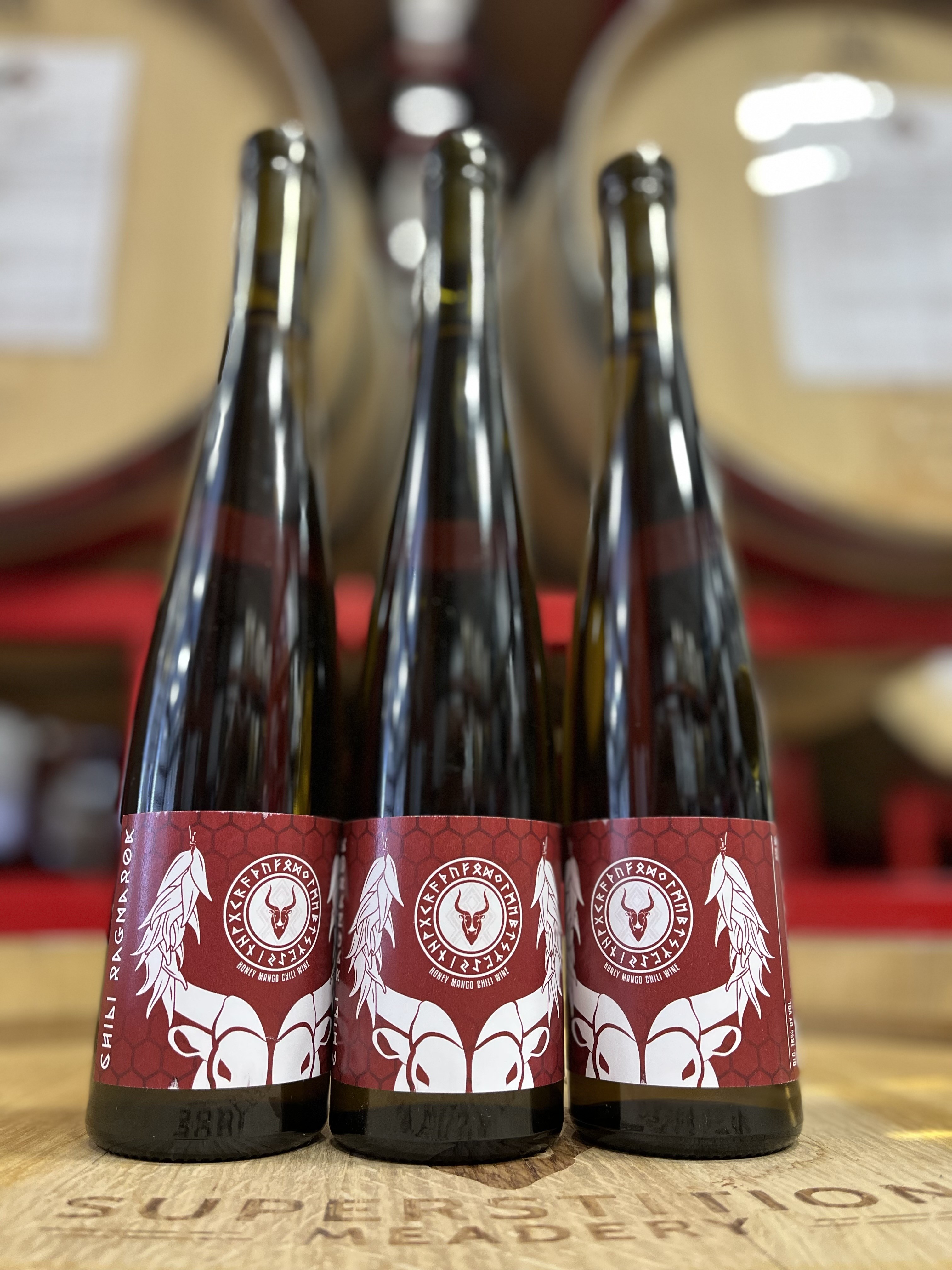
Superstition Meadery's Chili Ragnarok, a mead made with mango and Hatch red chiles. 
Courtesy of Superstition Meadery

Superstition Meadery

1110 East Washington Street 
superstitionmeadery.com
Sunday - Thursday, 11 a.m. to 9 p.m.; Friday - Saturday, 11 a.m. to 10 p.m.
Superstition Downtown’s staff is getting into the spirit by dressing up in mead-related costumes, from Vikings to riffs on the imagery from Superstition's bottle labels. Any customer who does the same – here or at their Prescott location – will get 25 percent off any bottle or can of mead, which they can enjoy onsite or take home. In advance of the weekend, Superstition will release several special meads, including Chili Ragnarok made with mango and Hatch red chiles and Invisible Smile, a peach-flavoured cyser style, which combines apple juice and honey.
Scale & Feather Meadery owners, from left, Tamara Chaney, Ben Chaney and Amber DeGiso. 
Courtesy of Joey Tru

Scale and Feather

1050 North Fairway Drive, Building E, Suite 112, Avondale
scaleandfeather.com
Tuesday - Thursday, 4:30 to 8 p.m.; Friday, 4:30 to 9 p.m.; Saturday, noon to 9 p.m.; Sunday, noon to 4 p.m.
Scale and Feather will have two special releases for the holiday. Try the Fey Dark, a raspberry chocolate session mead, or the Knight of Everflame, an agave barrel-aged version of their award-winning Mantle of Whispers. It combines mesquite blossom honey mead with roasted Hatch green chiles and vanilla. Or, beat the heat in this medieval-inspired tavern with an orange blossom honey vanilla or raspberry flavoured mead slushy.

Owners Heather Hurst-Kline and Uwe Boer opened Celestial Artisan Meadery in Carefree in February. 
Karie Campion

Celestial Artisan Meadery

100 Easy Street, Carefree
celestialartisanmeadery.com
Tasting room reopens on Sept. 2
Celestial Artisan Meadery is the Valley's newest destination for honey wine, opening in February 2022. Their Carefree taproom is temporarily closed at the moment, but you can order their meads and ciders directly from the website or use their mead finder to locate stores, including Total Wine, that have it in stock. Taste the Tart Cherry Quasar or the Easy Street 101 Hard Cider.

Visiting Arizona Mead Company is like being in your homebrewer friend's basement. 
Allison Trebacz

Arizona Mead Company

6503 West Frye Road, No. 12, Chandler
azmeadco.com
Friday, 5 to 9 p.m.; Saturday, 3 to 9 p.m.

At Arizona Mead Company you can sip chilled meads from the bottle, along with kombucha and cider on tap. While they won’t be doing any special releases for Mead Day, they are open on Friday and Saturday, so you can tuck into their cosy space or order ahead and pick up.

https://www.phoenixnewtimes.com/restaurants/these-taprooms-serve-arizona-made-mead-where-to-find-local-honey-wine-phoenix-14147916 

Wednesday, 3 August 2022

The Big Welsh winners of the Great Taste Awards 2022

From walesonline.co.uk

Some Welsh businesses have been awarded the top award of three stars for their products 

The Great Taste Awards have been announced for 2022 and among the Welsh winners are luxury ice cream and sea salt. Eight Welsh companies and businesses have been awarded the top award of three stars for some of their products.

Great Taste is the world’s largest and most trusted food and drink accreditation scheme, that tests both food and drink. The awards have been running since 1994 and the products are blind-tasted by selected chefs, cooks, buyers, retailers, restaurateurs, food critics and writers.

Three stars mean the product is exquisite and only around 2% of products tested each year are awarded three stars. 

                                     Businesses awarded three stars include The Wye Valley Meadery


The 3-star winners from Wales in 2022's Great Taste Awards are:

Fecci's Ice Cream (trading as Mario's Luxury Dairy Ice Cream) for their Espresso Martini Ice Cream in Cross Hands, Carmarthenshire

Best of Hungary Ltd for their Formanek Vineg'Art Tarragon Vinegar in Machynlleth, Powys

Netring Ltd (trading as Allaways Coffee) for their Bay Coffee Roasters - Indonesian Sumatran Fairtrade Organic in Tanygroes, Cardigan Bay

Tasty Bites at Ionas Kitchen for their Curried Goat Patti, in Gwent

Parva Spices for their Sambal Hijau in Tintern Parva, Monmouthshire

The Wye Valley Meadery for their Hive Mind: Big Smoke - Smoked Honey Porter in Portskewett, Caldicot

Pembrokeshire Sea Salt Co for their Sea Salt with Saffron in Bridge Farm, Newport

Pembrokeshire Lamb Ltd for their Hogget mince in Treffgarne, Haverfordwest

https://www.walesonline.co.uk/whats-on/food-drink-news/big-welsh-winners-great-taste-24651024