Saturday, 19 August 2023

Exploring Honeywine: Schramm’s Mead, Kansas City

From porchdrinking.com

By Eric Griffin

Craft beer is not the only industry to see a huge boom recently in both production and popularity. As drinkers today are always on the hunt for something new and exciting, the versatility of honeywine has found large appeal with a range of different demographics, and has led to the opening of countless full-production meaderies across the United States. Schramm’s Mead has been a top producer of honeywine for a decade now. They’ve helped to pioneer the continued growth of the style as well as set the benchmark for quality and success. We had the privilege to sit down and talk with Ken Schramm, co-founder and head meadmaker of Schramm’s, to learn more about their roots, program development, and some of the other pivotal factors he has pioneered that have further impacted the sweeping mead revolution that our country is seeing.

The Road to Schramm’s

Home-brewed Beginnings

Ken Schramm, like a large number of other Meadmakers, started off as a homebrewer, and a self-proclaimed beer geek. In the 1970’s there wasn’t much in terms of complexity of style in the U.S. Much of the fascination for those uninterested in the American Light Lagers of the era was directed toward European beer. Whether it was full-bodied German lagers, Belgian Lambics, or countless other Old World styles, Ken always gravitated toward the exploration of beer’s potential.

Fast-forward to Christmas of 1987. Ken and some other family members got homebrewing kits, learning the basic processes under the guidance of their cousin Dave. It didn’t take long before all of them were hooked. Ken joined the American Home Brewers Association in 1988, and not long after received his first copy of Zymurgy magazine. He learned about Bill Pfeiffer, 1985 Meadmaker of the year, one of the five nationally recognized Nationally ranked beer judges, and who happened to live only a few miles from Ken.

Expansion & Connection

Time moved quickly from there. Under Bill’s generous mentorship the two started out by expanding their knowledge and early work. This began through the joining of the Ann Arbor Brewer’s Guild. It was through this Guild that Ken met Dr. Dan McConnell, a well-known microbiologist who would later help Ken found the Mazer Cup along with a man by the name of Mike O’Brien. The trio also started the Michigan State Fair Home Brew Competition, and Ken and Dr. McConnell both conducted early presentations together on mead, mead judging, and fruit beers.

Drawn to Mead

By the early 1990s, Ken had really began to shift his focus toward mead. Particularly, he was drawn to honeywine because of the initial scarcity of commercial examples. While beer had its set of categories and definitions for all the varying styles, mead had no set definition for what it was “supposed” to be. With a truly creative approach and grounded determination, he knew he could get to the point where he could use his “mind’s tongue” to visualize and conceptualize a beverage that he wanted to create. The guidance of Bill Pfeiffer was paramount during this period of time. It taught Ken how to really understand the process of piloting. Specifically, doing the work that needed to be done progressively, one variable at a time, in order to reach a set goal.

Through this process, Ken quickly honed in on where he wanted to be. Factors such as growing his own fruit, adjusting the amount of fruit used in a recipe, seeing the difference that varying yeast strains could make, and monitoring how specifically he targeted his free amino nitrogen load all were examples of things that affected his outcomes.

Scaling Up

After at least 30 different batches of The Statement, which has since become a mead synonymous with some of the best in the industry, it became time to tweak just a bit further to account for the next step, which was to make the recipe commercially scalable.

The Statement was the first mead Ken entered into a Mead Competition (The Mazer Cup), and it won First Place. He made a point to say that The Statement wasn’t even his best mead at the time. As just one in a growing portfolio of successful recipes, you could say the rest would be history.

The Mazer Cup

Anybody remotely involved in mead is familiar with the Mazer Cup. With over three decades of competition under its belt, the Cup, founded by Ken Schramm, Dan O’Connell, and Mike O’Brien, has always prided itself in being an event produced and operated by mead-lovers across the U.S. With the goal to restore Mead to its rightful place as a mainstream beverage, the Cup has earned its title as being the largest and most prestigious commercial and amateur mead competition in the world.

When talking with Ken, he recalled the inaugural Cup in 1992 only having 47 total entries. This number has skyrocketed over the years. The 2022 Cup received over 300 entries in the Commercial Cup alone, and another 457 entries in the Home Competition. This massive increase speaks volumes to the exponential growth of popularity in honeywine over the last 30 years.

Ken no longer runs the Mazer Cup, making the decision long ago to put family first as well as to continue to pursue mead education. For over 10 years now it has since been placed in the more-than-capable hands of Pete Bakulić and Carvin Wilson, after merging with the competition from the former International Mead Festival.

In regards to the Mazer Cup International Competition for 2023, here is the most up-to-date information of scheduled events:

  • Registration will be from 09/01/2023 – 09/15/2023
  • The shipping window for submissions will be 09/16/2023 – 10/15/2023
  • Judging will take place in Kansas City, MO, with the main judging taking place from 11/02/2023 to 11/04/2023. Winners broadcasted on Sunday Evening, 11/05/2023.

Cheers to 10 Years
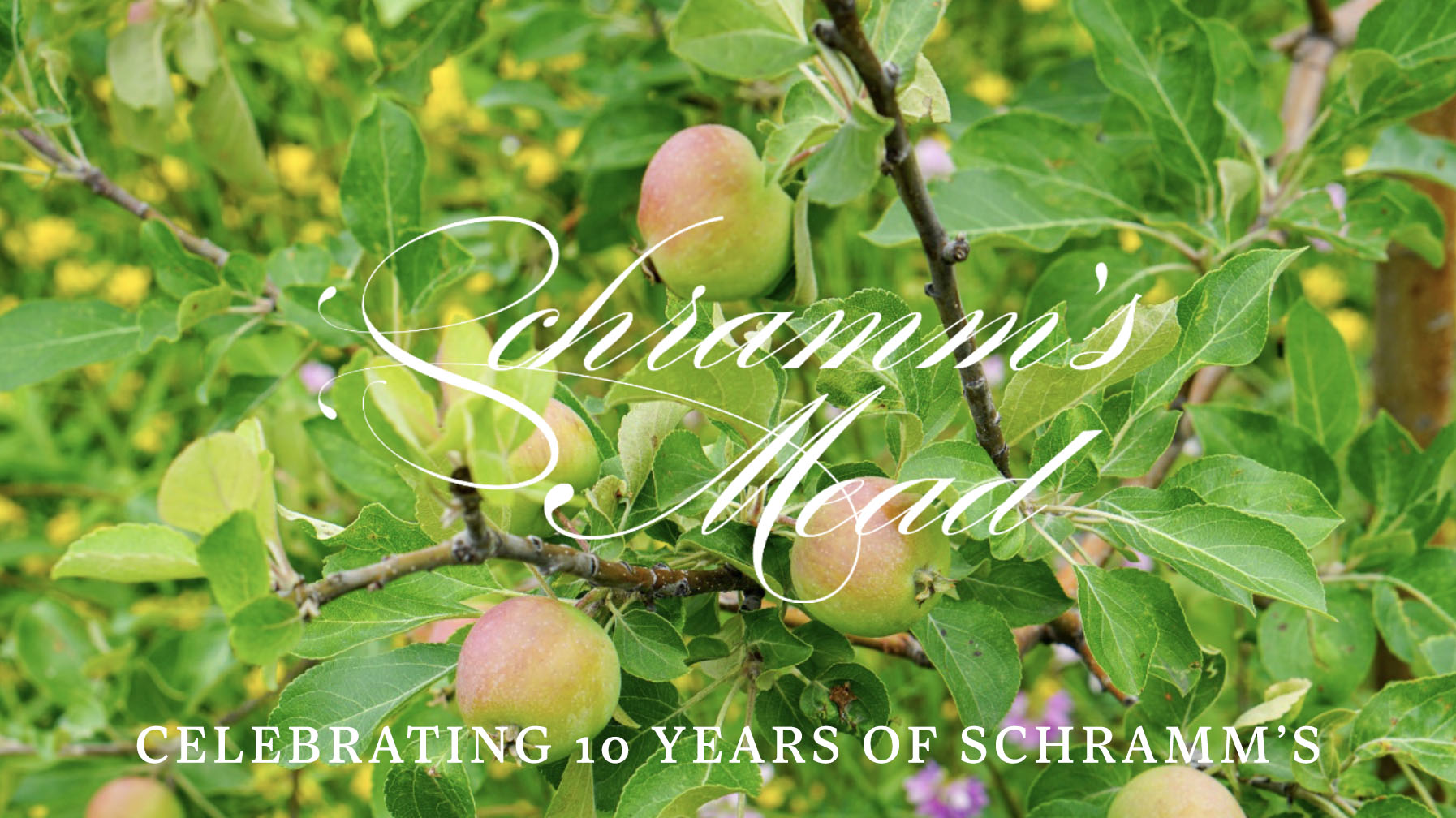
Focal Image for Schramm's Mead Anniversary
Photo Courtesy of Schramm’s Mead

In addition to the Mazer Cup having just celebrated its 30th year of competition last year, Schramm’s Mead is celebrating its 10 year anniversary as well. There are exciting celebrations happening now to honour the last decade, and the meadery has exciting plans for the future.

Schramm’s recently purchased an orchard. As is the case with anyone involved in the business of high-end fruit beverages, the quality of ingredients cannot ever be truly controlled unless it is produced independently. As stated by Ken, “you can’t make a silk purse out of a sow’s ear.” There’s so much to be learned, and Ken is excited for the future of experimentation. That, and creating the best product they possibly can.

Growth Over Time

As growth and education in the Mead industry has continued to grow over the years, so too has Schramm’s in their development of world-class honeywine.

Back when The Mazer Cup had just gotten off the ground, and still about a decade before Ken published his hugely popular and successful book The Compleat Meadmaker, there was a period of time where there wasn’t very much information readily available to contribute to the successful production of high-quality mead. In the early 90’s it was only just becoming popular, and there was hardly any information on the behavior of different yeast strains in mead or about varietal honeys. This created a severely constricted commercial market.

Leave it to Ken Schramm and Dan O’Connell to do something crazy. In 1993, the two set out and created separate batches of mead highlighting a single varietal honey and its interactions with six different yeast strains. They simultaneously conducted the opposite experiment, utilizing the same yeast with six different varietal honeys. Finally, they combined the six variety honeys and fermented that blend with that same yeast strain, and proceeded to serve the 13 meads in a single session at the 1994 American Homebrewer’s Association National Conference. What the two were able to educate members of the Association on was mind-blowing, and set the stage for Ken to continue his expansion of mead knowledge as far as he could. Not to mention, many of those tasting the meads and listening to Ken and Dan talk that day went on to become incredibly successful, award-winning meadmakers in the years to come.

The Schramm’s Program

Ken noted that one of the most rewarding aspects about building popularity, growth, and education about a virtually unknown style of alcoholic beverage has been the ability to be essentially uninterrupted in his thirst for knowledge. He used the recognition of growing their own fruit at Schramm’s as an example of something particularly important to him. It was something that he learned over the years was critical to creating the best product they could.

Arguably the most important thing that Ken has come to realize over the course of his years in the industry is that mead has a big awareness burden that it has to overcome. That is to say that while growing from almost zero knowledge in the U.S. to still a minority sample having an idea of what mead is, it’s an issue that in comparison to beer and wine has never been seen before. The road ahead is undoubtedly still a long one when discussing the education of consumers about mead. That said, for those more aware of the movement, there is no argument that for the last decade, Schramm’s Mead has been synonymous with success and quality in the mead industry.

“What I’ve been striving for in the meads that we make is in creating something intrinsically delicious. We wanted people to be able to be able to open a bottle of our mead, pour it and never question its deliciousness.”

Ken was generous enough to send a sample our way to review, allowing us to showcase their 5th Batch of A Smile of Fortune. This mead is a more-than-fitting example of what we had the privilege of discussing with Ken.

A Smile of Fortune

This is a dark fruit mead made with Black Currants, Polish Lutowka Cherries, Heritage Red Raspberries, and Oregon Boysenberries. As a true-to-form Schramm’s Mead, this intensely bold honeywine recommends pairings with fresh young cheeses, pork, and Mindo chocolate.

The Review

                                                                               Photo Courtesy of Eric Griffin


As mentioned, we had the opportunity to review A Smile of Fortune, which finished at 12.5% ABV.

The pour is a bold, deep, brooding crimson. When swirled, there is great leg retention as the mead funnels back down the glass.

Bright, acidic cherry and boysenberry spring to the forefront of the nose. With time in the glass, the sweetness of the berries intensifies, bringing forth a fantastic bouquet of blackberry jam.

The palate is an exceptional balance of mildly drying tannin, medium acid, restrained tartness, and rich honey sweetness. Coursing through the mid-palate is cherry preserves, Ruby Port, and fresh blackberries. On the tail is pleasantly warming ethanol and the slightest puckering tartness as it trails off.

While at first sip this mead introduces itself with a seemingly elegant simplicity, after given time to open up in the glass and accustom itself to the palate, it proves to be so much more. The tannin, the acid level, the tartness to balance the jam, and the warmth on the finish to round it out. All these factored in expertly into a balance that very few meaderies are capable of achieving. There is a reason why Schramm’s is the name synonymous with mead in today’s market. Truly exceptional.

The Long Game

Mead has seemingly always been playing catch-up. Education on honeywine over the last 30 years has done wonders for the industry, and the growth has been amazing to see. Ken Schramm has been one of the industry’s largest advocators and educators, and his Meadery has produced some of the finest honeywine found anywhere in the world.

Ken left us with the reminder that the only way to get the knowledge is to do the hard work. More specifically, play the “long game.” Study these beverages elementally. Beer is a balance built upon malt, body, bitterness, hops, carbonation, and mouthfeel. With mead it comes from sweetness and acidity, fruitiness and body, and in both instances, alcohol content and its contribution. Achieving balance of these elements is key, and what Ken dubbed the “mind’s tongue.”

The road ahead in this still-niche industry is a long one when it comes to education and the continued growth of its popularity. But thanks to Ken Schramm and the people that he met along the way, it is on the right track. Schramm’s Mead has set the benchmark. That said, there are so many promising meaderies coming up with bold, unique, and delicious honeywines of the highest quality. If you haven’t already, it’s about time you see what all the buzz is about.

https://www.porchdrinking.com/articles/2023/08/18/exploring-honeywine-schramms-mead/ 

Sunday, 13 August 2023

12 US Meaderies You Need To Keep On Your Radar

From thedailymeal.com

Some American states, like Tennessee, are known for their whiskey. Other states, like New Hampshire, are known for their craft beer. California is renowned for its wine. But then there's mead; the new kid in town. It's not a recent invention — it's been around for about 20,000 years and is often associated with the medieval era — but the drink is having a resurgence in popularity.

Traditionally, mead has a sweet taste. This is due to the fact that it's made from honey, which is why it's sometimes referred to as honey wine. These days, you'll also find dry and semi-sweet meads. In modern society, the mead trend is increasing production. Across the United States, meaderies are popping up everywhere. 

If you're keen to try mead for yourself, where do you start? We've rounded up 12 meaderies you need to keep on your radar — there's sure to be one near you, or one offering shipping.


1. Honeytree Meadery — Nashville, Tennessee

Tennessee is all about whiskey, right? Wrong. Ross Welbon, a beer brewer and beekeeper, and Dru Sousan, a bartender with a long history in Nashville's local restaurant scene, are making the state one of the best places in the U.S. to get your mead on.

Honeytree Meadery stands out from the crowd by having its own apiary, home to over 30 bee colonies. It's also Nashville's first meadery, opened in 2019, and the sunny backyard patio is the perfect place to sample a glass — or two — of the stuff. There's even an on-site taco truck, as you're going to need some hearty grub to soak up all that booze. The meadery's tasting room is open most evenings during the week, as well as starting at noon on weekends. You can even book a tour if you want to see mead-making in action.

Every glass of mead produced by Honeytree packs hints of the specific honey used to produce it, from orange blossom to wildflower honey. Some of the meadery's beverages are even made with custom aromatic infusions, ranging from fresh ginger to pineapple. We'd recommend starting out with the Basic Batch Mead, a semi-sweet mead made simply from dark wildflower honey, yeast, and water.


2. Heidrun Meadery — Point Reyes Station, California

Heidrun Meadery — located in Point Reyes Station, California – is one of the older meaderies in America, having opened in 1995. In 2012, the meadery expanded and now has its own commercial beekeeping operation. Heidrun is the brainchild of geologist-turned-brewer Gordon Hull, who started playing around with meads in his spare time, before deciding to turn his hobby into a business.

Unlike traditional sweet mead, the mead brewed at Heidrun Meadery is champagne-style mead made from wildflower and monofloral honey. Each mead comes in a beautifully labeled bottle with its own detailed story. You can try the Dakota Chokecherry Blossom, named after Dakota's state fruit, with its mild flavors of sour cherry, or pop open a bottle of California Sage Blossom if you prefer your mead on the sweet side. It's made with black sage honey and contains notes of melon, as well as an aroma of jasmine.

Want to visit Heidrun? The meadery is open seven days a week, so you can pop in to sample some mead on the patio or book a guided tasting.


3. Four Fires Meadery — Maumee, Ohio

Just like craft breweries, some of the best meaderies started small, like Four Fires Meadery in Maumee, Ohio. It began with four friends making mead out of a garage. These days, the meadery is a larger operation.

Four Fires Meadery shies away from traditional sweet mead, with some imaginative flavor combinations you won't find anywhere else, and equally inventive names. Don't live in Ohio? The meadery offers nationwide shipping, so you can enjoy a glass or two of Four Fires mead wherever you are in the country. If you're lucky enough to live locally, pop along to one of the meadery's street food pop-ups and sample some delicious mead for yourself.

Try the 2022 Flower of Carnage, a mead made with Black Arkansas apples, Black Mission figs, and local black walnuts. You could also sample the 2021 Semi-Charred Kind of Life, a redcurrant mead aged in bourbon barrels.


4. Meridian Hive — Austin, Texas

Meridian Hive in Austin, Texas, was founded in 2013. It partnered with an apiary in Mexico in 2019, ensuring that all the orange blossom honey used in its mead is high-quality, ethical, and sustainable. Botanicals, spices, and fruit are added to create the meadery's wide range of meads, which are free from artificial ingredients and processed sugars.

Meridian Hive's meads are also available in cans, making it a portable choice for picnics and festivals. Popular flavors include Honey, Blackberry, Lemon, and Peach. Can't choose a favorite flavor or want to sample them all? The meadery's website sells a mixed pack of 12, 24, or 48 cans in four flavors: Blackberry, Honey, Peach, and Lemon. If you're looking for something lighter, Meridian Hive also creates Skinny Bee, with natural ingredients, 2 grams of sugar, and 100 calories per can. Skinny Bee comes in Blueberry, Cranberry, Grapefruit, and Acai Berry varieties.

You could also treat yourself to one of the brand's specialty meads. These tend to have a higher ABV. It comes in flavors such as Bastani Delight (made with lychee, rose, and pistachio) or the South Paw (made with paw-paw fruit and aged with American Oak).


5. Superstition Meadery — Prescott, Arizona

Superstition Meadery in Prescott, Arizona, is the perfect antidote to beverage boredom. This imaginative meadery makes mead from anything and everything, with some truly creative flavor combinations. The meadery has created over 300 unique meads since 2012, as well as a range of hard ciders.

Don't live near Prescott? You can join the Mead Club to get mead shipped to your doorstep every month. This is a great way to dive into the meadery's seasonal flavors. If you live near the meadery, you can pop in for a tour and tasting. Head to Superstition Downtown, in Phoenix, or Superstition Tasting Room, in Prescott, where you can sample the meadery's range of beverages, alongside some food.

Packaged in bottles with arty, colorful labels, Superstition's mead is anything but dull. Try the 2022 Rye Whiskey Barrel Aged Desert Monsoon with prickly pears and Arizona honey, or give the 2023 Ginger Voodoo a go. Packed with honey and spicy ginger, it's the perfect complement to lamb or jerk chicken.


6. Schramm's Mead — Ferndale, Michigan

Schramm's Mead is located in Ferndale, Michigan. The mead here is more traditional than some you'll find at other popular meaderies, but that doesn't stop the flavours from being imaginative.

These meads come in flavours of berry, nutmeg, ginger, and more. The Ginger mead has a subtle spice that's the perfect complement to Thai or Indian food, or sushi. The Statement is a Balaton cherry mead is another must-try beverage. It would pair great with blue cheese, chocolate, or grilled pork.

One reviewer on Google praised Schramm's Mead highly, saying, "The mead? IMO, the best in the world. Outstanding experience — will be back as soon as the stash I bought runs out." Another reviewer was equally as enthused with the meadery's beverages, commenting, "This is definitely the best mead I've ever had, and I would go as far as to say the best alcoholic beverage I've ever had."


7. Pips Meadery — Gurnee, Illinois

Pips Meadery is a family-owned meadery in Gurnee, Illinois, that offers up thoughtfully-crafted meads. Not afraid to experiment with flavour combinations, Pips Meadery has plenty of interesting choices to suit all tastes, whether you're new to mead, or a seasoned lover of honey wine.

The meadery aims to push boundaries with big, rich, intensely flavoured meads like Black Currant Pancake, a blackcurrant mead with maple, cinnamon, and vanilla that's aged in bourbon barrels. Another delightful-sounding mead is Levitation, a deeply fruity blueberry mead with a hint of mint. Sadly, Pips Meadery doesn't currently ship its mead, so you'll need to visit the meadery itself to try some of its delicious beverages.

The Parlor, the meadery's taproom, is open Thursdays from 4 p.m. to 9 p.m., Fridays from 2 p.m. through to 10 p.m., Saturdays from noon to 10 p.m., and Sundays from 11 a.m. to 3 p.m. Though there isn't any food served, you can bring your own, order delivery, or take advantage of the nearby food trucks — when they are available.


8. B. Nektar — Ferndale, Michigan

B. Nektar

If you're new to mead, you may not have heard of B. Nektar. But it's been around for years, as it was founded in 2008. B. Nektar aims to bring a modern twist to mead. It was even ranked in the Top 100 Best Breweries in the World by Ratebeer.com.

The mead created here is anything but traditional, both in flavor combinations and names. Imaginatively-titled libations include The Mutant Killer Zombie Manhattan Project Thingy, an apple mead spiked with cherry and aged in rye whiskey barrels. There are also meads like Dragons Are Real, a spicy cherry chipotle mead with cacao nibs, aged in New Holland Brewing Dragon's Milk barrels.

B. Nektar's taproom has an outdoor, pet-friendly patio and serves up light snacks to accompany your meads of choice. You'll also find visiting food trucks from time to time if you fancy something heartier. You can also bring your own food, or order delivery to the taproom! If there are enough staff on shift, you can even ask for a tour of the meadery.


9. Zen Bee Meadery — Worthington, Ohio

Family-owned and run Zen Bee Meadery is located in Columbus, Ohio. The company began brewing back in 2016. It specializes in making lower-ABV Session Meads and Honey Ciders. The meadery has won many awards, including a 2020 National Honey Board Winner Best of Show award. Additionally, the meadery's Mara Ume won Best in Show at the second annual Mead Crafters Competition in 2020.

Zen Bee uses high-quality varietal honey — locally sourced wherever possible — as well as spices and fresh fruits to create all its meads. There are four year-round flavors: Everyberry, Pear of Peaches, Pink Zilla, and Jacked Cherry. The meadery also releases a new seasonal flavor every month. Past flavours include Banana Royale with banana, strawberry, and vanilla. 

To try Zen Bee's mead for yourself, visit the Tasting Room. It's open for flight tastings and bottle sales Wednesdays and Thursdays from 4 p.m. to 8 p.m. and Fridays and Saturdays from 4 p.m. to 10 p.m. If you live in the Columbus area, you can also order online for delivery, or check the meadery's website for local stockists.


10. Garagiste Meadery — Tampa, Florida

Tampa's Garagiste Meadery is the largest publicly funded meadery in history, opened in 2016 following a successful crowdsourcing campaign. According to the company, the name Garagiste means "A small-scale entrepreneurial wine-maker who does not adhere to the traditions of winemaking." Garagiste certainly shirks the norms, brewing innovative, creative meads offering something a little different from the rest.

The Tampa Heights taproom is open Thursdays from 3 p.m. until 9 p.m., Fridays and Saturdays from noon to 10 p.m., and Sundays from noon until 7 p.m., pouring an ever-evolving selection of Garagiste's finest meads. You can see what's currently pouring on the meadery's website, or order online for taproom pick up or delivery.

Try inventive meads like the Barrel Aged Rocket Fuel 2022, a fortified mead with red currants, cherries, apricots, and boysenberries. It's aged for 17 months in a Heaven Hill Barrel and has an 18.5% ABV. You could also dive into the 2023 Vanilla Tutti Frutti, with a Komoros and Madagascar vanilla base, as well as loads of red fruits, like cherries, raspberries, and strawberries.


11. Second City Meadery — Chicago, Illinois

Second City Meadery in Chicago was founded after its owners visited Detroit and discovered the city's outstanding meaderies. Today, the meadery specializes in producing some of the more unusually flavored meads out there. Its Existence is Pain mead won the bronze medal in 2020 at the second annual Mead Crafters Competition conducted by the National Honey Board.

Visit the taproom to try Second City's offerings for yourself. It's open Thursdays and Fridays from 6 p.m. until 11 p.m. and Saturdays from 1 p.m. until 11 p.m. The meadery's website is regularly updated, so you can see what's pouring before making the trip. 

At the time of writing, recently poured meads include delights like the State Lines Banana Split, a collab with Hex Meadery that's flavoured with bananas, cocoa nibs, and strawberries. The meadery also made something called the Barrel Aged Wake Up, which is made with cold brew coffee.


12. Brothers Drake Meadery — Columbus, Ohio

Brothers Drake Meadery opened in 2007 in Worthington, named after Eric and Woody Drake, brothers who have been creating mead for years. The meadery uses local Ohio honey and isn't afraid to experiment with flavor combinations. Brothers Drake now has two locations. Head for the Grandview Heights location for a tour and tasting with Mead Master Julian Menaged. Tours run Saturdays at 2 p.m. and 4 p.m. and Sundays at 2 p.m. You can book one of these ahead of time.

The original Short North location is now a tasting room, with the back room used for barrel aging meads. The tasting room is open Wednesdays and Thursdays from 5 p.m. to 11 p.m., Fridays from 4 p.m. to 11 p.m., Saturdays from 2 p.m. until 11 p.m., and Sundays from 2 p.m. until 8 p.m. Wednesday is Jazz Night, kicking off at 8 p.m. If you're not local to the area, you can buy Drake Brother's mead online for delivery, depending on your state, or join the Mead Club, which delivers mead on a quarterly basis to let you try out new and seasonal flavours alongside classics. 

Currently, available meads include the 2023 Bourbon Barrel Battle Axe, a 15% ABV mead made with juniper berry, cranberry, and vanilla. Or try the 2023 Blueberry Chai, a 13% ABV mead made with blueberries plus cinnamon, honey, and cardamom.

https://www.thedailymeal.com/1360955/us-meaderies-need-keep-radar/


Friday, 11 August 2023

Mead has a long history and a future as a sustainable beer alternative

From washingtonpost.com

When Brett and Megan Hines moved to Colorado for graduate school in 2011, they immersed themselves in the New Age subcultures that were taking root in the state at the time. The Eastern Shore Maryland natives took up mountain biking, joined a CSA, volunteered at an organic farm, raised chickens, drank craft beer and eventually joined a home-brewing club, called Liquid Poets, to learn how to make their own. Brett even parlayed the hobby into jobs brewing for local labels. 

But the deeper the Hineses delved into the world of ales and lagers, the more they realised that the industry was out of sync with their emerging environmentalist worldview.

“We wanted to go with our values of sourcing as much local product as we could,” says Megan Hines. “We wanted to make a truly local beverage. And a lot of grain is grown far away at a big commercial scale. Bringing grain in from across the country is not a sustainable long-term thing.”


During their time with the Liquid Poets, the Hinses learned of a different fermentable, one that was made without grain. Mead was essentially honey and water, flavoured with fruits and spices from perennial plants. And they found it every bit as delicious and versatile as beer.

In 2014, the Hinses moved back to Maryland to set up their own organic vegetable farm. They bought sheep, goats, pigs, chickens and bees to raise and planted an apple orchard. But instead of brewing beer, the couple made mead. Six years later, they opened The Buzz Meadery in Berlin, Md.


Mead has ancient roots, predating human agriculture, with origins at least as far back as the New Stone Age. Over the past decade-plus, the beverage has found a foothold in the ongoing craft beverage movement — a recent report from Technavio research group projected mead to be a $2.26 billion global market by 2026. And while Europe, steeped in the mead-making tradition, still holds the largest chunk of that market, the U.S. is closing fast. The American Mead Makers Association (AMMA) reports that the number of domestic meaderies blossomed from just 60 in 2003 to 450 in 2020 — with some 200 more somewhere in the planning stages of opening before the pandemic hit.

Megan and Brett Hines opened The Buzz Meadery in 2020 as a more environmentally sustainable alternative to brewing beer. (Brendan McCabe/for The Washington Post)


Mead’s modern resurgence can be linked to several factors, from appealing to gluten-free drinkers to an association with mainstream fantasy fiction like “Game of Thrones” to sheer novelty. Long-standing industry leaders such as Michigan’s B. Nektar (founded in 2006) and Colorado’s Redstone Meadery (2001) have turned their niche followings into well-known national brands. But whatever the reason for its current popularity, the ancient drink might owe its future to the fact that, in many ways, it’s better for the Earth than beer.


“Mead is perhaps headed to be the drink that, if it’s made as it can be and stays in its own environment, can be the lowest carbon-footprint beverage there is,” says Ken Schramm, owner of the renowned Michigan-based Schramm’s Mead, who has been making the stuff for 35 years and wrote 2003’s “The Compleat Meadmaker,” still considered the authoritative manual for the craft. “If you drink it where you’re at, the whole thing ends up being a very carbon-positive product.”


Proximity is a key differentiator for mead when it comes to carbon footprint. The primary ingredients in beer are barley and hops, the production of which are both mainly concentrated in the western and northwestern regions of the U.S. According to the Hop Growers of America, Washington state produces more than twice the amount of hops than does the rest of the country; and the USDA says that most domestic barley production — three-fourths of which is used for malting — is in Idaho, Montana and North Dakota.


Meanwhile, honey can be produced virtually anywhere, with North Dakota apiaries churning out about 31 million pounds, followed by a far-flung array of regions, including California (11.5 million pounds), Texas (8.32 million), Montana (7.5 million), Florida (7.35 million), South Dakota (7.2 million) and Minnesota (5.2 million). As Schramm points out, many leading meadmakers still import exotic types of honey from all over the world, but usually in much smaller quantities than are grains used to brew beer at commercial scale.


Saving on shipping might give mead a small leg up over beer (after all, honey is much heavier to move than an equal amount grain). But mead’s true viability advantage could lie below the topsoil. Barley, along with other adjuncts in beer, such as corn, rice and wheat, is an annual crop. That means every year, farmers plow and plant, releasing CO2 and carbon into the atmosphere. Those commercial crops often require use of potentially harmful herbicides and pesticides. Perhaps most important: In times of drought, these fields require irrigation.

The fruits generally used in making mead, on the other hand, grow from perennial trees and vines. And the honey?


“You don’t have to irrigate plants that rely on bees,” says Ayla Guild, beekeeper and co-owner of The Hive Taproom meadery, in East Troy, Wis. “During drought, bees are scrappy. They figure it out. Certain plants thrive in drought, and the bees know how to find them.”


Speaking of bees, meadmaking also has the carbon-positive impact of promoting the planet’s most prodigious pollinators, which keep carbon-eating forests and carbon-sequestering prairies healthy. Plus, there’s no strain on the insects’ supply. “Bees make surplus honey,” says Amina Harris, founding director of the Honey and Pollination Center at the University of California at Davis and “Queen Bee” of her family business, Z Specialty Food, LLC. “They’re going to make it whether they need it or not.”

A selection of The Buzz Meadery's meads and ciders, made with locally grown apples and local Maryland honey. (Brendan McCabe/for The Washington Post)

When it comes to actual production, mead requires far less water than beer. While beer wort - the liquid from the mashing process - is boiled, most mead is not. Between water lost in the boil, water used to cool the wort, and water used for cleaning equipment, a brewery could need eight gallons of water to brew one gallon of beer — and that doesn’t include the water-intensive steeping process of malting the grain. Breweries also have bigger physical and energy footprints – they usually require more space and more power than meaderies do.


Of course, part of mead’s overall environmental virtue is the fact that it is still a boutique business and a very tiny wedge of the larger alcohol industry (craft beer’s current U.S. market is nearly $30 billion). And maybe there’s a future in which mead mostly remains hyperlocal or at least regional, with Marylanders patronizing The Buzz, Pacific Northwesterners buying equally sustainability-minded Sky River, and tipplers of the Tri-state area drinking Melovino.


But if mead is to continue to grow as an industry, what’s to stop it from taking on some of the unsustainable traits of beer? Schramm says that the key is meadmakers like the Hineses continuing to capitalize on the inherent advantages of the craft and following a different business model from that of craft beer — that of its closer kin, wine.


“Beer is the ocean liner; we are the rowboat,” says Schramm. “We do have the potential. There’s a notion of having meaderies emulate the great wineries, having the beehives, berry farm and orchard all in one place. Then you can have something that is biodiverse and very environmentally conscious. Alcohol has done tremendous things for our culture. Now it’s time to have it do things for the environment.”


At Buzz, which this summer will release its first cans of carbonated session mead made with Maryland honey, Megan Hines says the calculus is simple: “I think everyone should be hyperlocal and lower environmental impact. Just support your local people.”


https://www.washingtonpost.com/food/2023/08/10/mead-sustainability-beer-alternative/

Saturday, 5 August 2023

Mead Day 2023 (US): Date, History, Significance, Facts

From newsd.in

Mead was produced by ancient civilizations and played a significant role in the mythologies of their respective cultures

Mead Day 2023: Annually, Mead Day is observed on the first Saturday of August. Mead is a fermented, alcoholic beverage that has been produced since antiquity. Mead was produced by ancient civilizations and played a significant role in the mythologies of their respective cultures. Mead is distinguished by the fact that its fermented carbohydrates are derived from honey. Honey is fermented with water to create mead. Additional ingredients, including fruits, flowers, and seasonings, were added. Honey wine is also known as mead. There are many different types of mead in the world, including still, effervescent, sweet, and not-so-sweet varieties.


The Background of MEAD Day

Mead Day is observed by devotees and brewers of mead. Ancient civilizations in Europe, Africa, and Asia brewed mead for thousands of years, and it remains popular today. This alcoholic beverage is produced by fermenting honey with water and any other desired ingredients.

Evidence of mead production has been discovered in northern Chinese pottery and European ceramic receptacles. Mead was also well-known to the ancient inhabitants of India and Greece.

The process of producing mead is comparable to that of producing wine. Mead can be readily made with wine yeast, and honey ferments at temperatures comparable to grape juice intended for wine.

Mead, unlike wine, undergoes both primary and secondary fermentation. The initial fermentation occurs relatively rapidly. Then, when the fermentation begins to subside, the mead is transferred to a new container through the process of racking. Racking is the process of transferring intoxicating beverages from one container to another using gravity instead of a pump, so that the beverage is not disturbed. The second, more gradual fermentation takes place in the second container.

After one to two months of primary fermentation, the mead is aged for six to nine months in the second container. The fermentation period is affected by the honey’s quality, its composition, the other ingredients used, and the ambient temperature.


Five essential facts about mead

  • During the Golden Age of Ancient Greece, between 500 B.C. and 350 B.C., mead was reportedly the most popular beverage throughout the nation.
  • Columella, a Hispano-Roman naturalist, recorded a recipe for mead in his agricultural work, “De Re Rustica.”
  • Due to the introduction of taxes on alcoholic beverages, commercial mead fell into obscurity until very recently.
  • In the event that mead is distilled to have the alcohol content of a liqueur, it may be referred to as whisky.
  • Small domestic meaderies introduced mead to the American public, and eventually commercial meaderies were established.


Why We Cherish MEAD DAY

We adore mead in all its forms, whether it is sweet, semi-sweet, carbonated, or flat, and we relish the opportunity to celebrate it.

With a special day set aside to celebrate mead, we have an excuse to seek out the finest meaderies in our region.

Mead is still an uncommon beverage, and we want people to know that it is still brewed and consumed!

https://newsd.in/mead-day-2023-us-date-history-significance-facts/

Wednesday, 2 August 2023

Hive Mind Wye Valley Traditional Mead Awarded Highest three-star Great Taste award rating

From newsfromwales.co.uk

Hive Mind Mead & Brew Co has been awarded the highest three-star Great Taste award rating for its Wye Valley Traditional Mead.

The Guild of Fine Food rates three star products as “extraordinarily tasty food and drink” and only 2% of the thousands of products submitted for Great Taste judging every year achieves three stars.

Hive Mind brews meads and beers at its meadery in Caldicot with natural ingredients and honey from its own local hives, where its beekeeping supports habitat conservation and important pollinator populations.

Hive Mind’s Traditional Mead reflects the flavours from the hills, meadows, hedgerows and woodlands of the Wye Valley through the honey that is harvested every season. To make the honey that goes into every bottle, the bees will have pollinated more than 1.7 million flowers and flown more than 70,000 miles.

The Great Taste accreditations celebrate the UK’s finest artisanal food and drink and are blind-tasted by a panel including celebrity chefs, Michelin-starred restaurateurs, food critics, buyers, retailers and writers. Three-star products go on to compete for Great Taste’s Golden Fork Awards, given to the best products in each nation and region in October

The judges’ comments described the Mead’ as: “Altogether beautifully crafted and thoroughly enjoyable…This is an absolute joy to imbibe and we love it.”

Judges’ tasting notes included: “A lovely complexity to this mead – well balanced throughout with woody and toasted notes and a soft sweetness rolling into a soft lemony acidity with a long finish”; “Smooth and silken on the palate with lingering floral notes on the finish. A really delightful and delicious mead with both fragrance and floral complexity”; and “A delightful, promising nose with a heady, blossomed fragrance to this gorgeous pale yellow mead. Softly sweet and nuanced, rounded and complex and deeply floral.”


This year, to help reduce food waste and prevent honey left over after the judging process being discarded, Hive Mind will be working with the Guild of Fine Food to collect the honey and brew a new ‘Great Taste’ mead.

Hive Mind’s tasting notes describe the Mead as sweet, rich and moreish with rich floral and heather notes. Hive Mind Traditional Mead is sold in classic cork-stopped 70cl bottles in numbered batches and is 14.5% ABV.

Hive Mind sells direct to consumers online and from its Caldicot tap house. It is available through independent delis, farm shops, bars and restaurants across the UK through specialist distributors including Pig’s Ears, Cotswold Fayre, Hammonds of Knutsford, Craft Drinks Co and Blas ar Fwyd.

The Traditional Mead, along with the whiskey barrel-aged version, has recently been added to the shelves of Selfridges and is used by Michelin-starred restaurants including Heston Blumenthal’s Fat Duck and James Sommerin’s Home, following an appearance earlier this year on a TV series with the Hairy Bikers focused on small artisan producers.

Hive Mind co-founder Kit Newell said:

“We describe our Traditional Mead as a distillation of the local landscape – it’s a well-balanced flavour that showcases the seasonality and all the floral notes from our carefully selected local honey, not just its sweetness. It’s a great example of how we’re working to modernise the perception of what mead can offer and how well it works as an alternative to sweet wines, spirits or ciders. It is also a fantastic after-dinner drink and pairs beautifully with blue cheese.”

“We’ve seen a huge surge in interest in mead in the US off the back of the growth in the craft beer market as people search out new and interesting flavours. And we’re delighted to be growing the profile and availability of mead in the UK through recognition by the Great Taste judges and the growing number of specialist distributors, artisan retailers and high-profile chefs supporting Hive Mind,” he said.

Hive Mind recently launched a range of flavoured session-strength Sparkling Mead (4%, 330ml cans). Other Hive Mind products include Oak Whiskey Barrel-Aged Traditional Mead (20%, 500ml) and honey beers including honey pilsner, Nectar (440ml 4.5%), smoked honey porter (750ml 7.0%), Citra IPA (330ml 5.7%) and golden ale (330ml 4.5%).

https://newsfromwales.co.uk/hive-mind-wye-valley-traditional-mead-awarded-highest-three-star-great-taste-award-rating/