Saturday, 26 March 2022

Tiny but growing craft mead industry carving out space in San Diego’s brewing landscape

From sandiegouniontribune.com

A half-dozen meaderies, including Lost Cause, Meadiocrity and Golden State, have opened in San Diego since 2010

Billy Beltz is bullish about mead’s future. The co-owner of San Diego’s Lost Cause Meadery predicts that honey wine will be the next big — oops, scratch that — the next not-so-big thing.

“It will never be more than a blip in the craft beverage industry,” he said.

While mead may never rival beer or wine in popularity, it has a growing fan base around the nation and in San Diego County. About a half dozen local meaderies, including Lost Cause Meadery, San Marcos-based Meadiocrity and Oceanside’s Golden Coast, have opened since 2010. This new generation of mead makers specializes in brews with vivid, fresh flavours — they are to the slick, cloying meads of yesteryear what Stone IPA is to Coors Light.

Lost Cause Meadery owners Suzanne Betz and Billy Betz inside the barrel room of their San Diego business on March 9.
Lost Cause Meadery owners Suzanne Betz and Billy Betz inside the barrel room of their San Diego business on March 9. 
(Eduardo Contreras/The San Diego Union-Tribune)

“The overall quality of the mead world is improving my leaps and bounds,” said Peter Bakulich, an amateur mead maker who runs the annual Mazer Cup International, the world’s largest commercial and amateur mead competition.

“We are using modern techniques that we are co-opting from wine making.”

Like beer and wine, mead is made with water, fermentable sugars — honey, as opposed to barley malt in beer and grape juice in wine — and yeast, which consumes those sugars to produce alcohol.

Yet the parallels are far from exact. Unlike wine or beer, mead also needs nutrients such as nitrogen to kick start the fermentation process.

There’s also little comparison in scale. The United States boasts 11,000 wineries and 9,000 breweries but just a little more than 400 meaderies. And even the largest meadery would be dwarfed by a healthy neighbourhood brewery.

“In the craft beer world,” Bakulich said, “the largest commercial breweries would be considered nano- or pico-sized.”

Small can be beautiful, though — and competitive. Based in Colorado and now in its 15th year, the Mazer Cup draws more than 1,100 entries from more than two dozen countries. Lost Cause and Mediocrity won two medals apiece in the 2021 competition. In fact, Lost Cause is a dominant player at the Mazers, nabbing a dozen medals in the last three years.

San Diego mead has a sweet story. Too bad so few have heard it.

On the production line, Biff Beltz bottles mead at Lost Cause Meadery in San Diego on March 9.
(Eduardo Contreras/The San Diego Union-Tribune)

“I still get people who, when I say ‘mead,’ they think it’s a butcher shop,” said Mike McCague, the owner, partner and brewer at Twisted Horn Mead and Cider in Vista. “They hear ‘meat.’”

For eons, mead was as commonly found on the table as meat. The brew is mentioned in the “Epic of Gilgamesh” (the ancient Sumerian poem), the “Odyssey,” the Bible and the plays of Shakespeare. In film and on TV, the drink is quaffed by rowdy Vikings.

This art is imitated by life, at least at Twisted Horn. The redwood-panelled tasting room is decorated with shields and hollowed out horns, the latter reserved for regulars who have been inducted into the meadery’s club, Odin’s Warriors.

If you’re a Dungeons & Dragons fan, this may be your kind of place. If you’re a buttoned down Marks & Spencer sort, it may catch your fancy as well.

“We have a very relaxed atmosphere, all-inclusive,” McCague said. “We could have a guy in a suit sitting next to a guy in chain mail.”

These days, mead maniacs are less apt to pillage villages than lead campaigns on behalf of their essential, yet unpaid, workers: the bees who visit flowers and other plants to collect the nectar that becomes honey.

At Meadiocrity meadery in San Marcos, co-owner Mark Oberle works in the company's production area.
(Charlie Neuman/Photo by Charlie Neuman)

“One of the challenges of our industry,” said Mark Oberle, owner and meadmaker at Meadiocity, “is managing a biological process.”

Meadiocrity’s meads mainly rely on the company’s 100 to 150 hives, home to 6,000 bees. The hives are moved twice a year, spending the cooler months in Valley Centre and the warmer months on Palomar Mountain.

Oberle tries to time these shifts to coincide with wildflower blooms, but nature doesn’t always cooperate.

“Ideally,” he said, “you have multiple rain storms during the winter, with one just before the flowers bloom. This year was very, very dry — just one wet spell — and the flowers opened very early.”

To fill the gap, Oberle has been importing honey from Lebanon, Dubai and other Middle Eastern locales. This is liquid gold; it’s not uncommon for one pound of specialty honey to command $70 or more.

The orange blossom and clover honey found in supermarkets can be used to make mead, but different varieties deliver different flavours. The Meadowfoam blossom honey found in Lost Cause’s Cloud Fluff, for instance, imparts marshmallow and vanilla flavours.

Beltz uses dozens of ingredients in his meads, everything from chili peppers and candy cap mushrooms — these smack of maple syrup — to pecans and tangerines. But to be classified a mead, the brew must be at least 51 percent honey, whether avocado honey, western buckwheat honey or exotics like Bracatina Forest honey.

A display of awards for mead excellence at Lost Cause Meadery in San Diego.
(Eduardo Contreras/The San Diego Union-Tribune)

While Beltz acknowledged this is still a niche product, he’s seen it gaining traction in an unexpected quarter: craft beer fans.

“Talk to any beer drinker who is following the craft beer industry,” Beltz said. “They not only know what mead is, there’s a good chance they are a fan.”

Beer fans may be intrigued by Lost Cause’s Level 6 Laser Lotus, which uses El Dorado and Citra hops, commonly found in IPAs, alongside wildflower honey and raspberries.

Wine fans may notice that Strike the Sun, one of Lost Cause’s 2021 Mazer Cup winners, is made with Riesling grapes. (There’s also kiwi, kumquat and Brazilian acacia honey.)

Others may be pulled in by something more primal, harking back to our distant, half-forgotten heritage.

“Mead is this direct route back to our common ancient ancestors,” said Frank Golbeck, co-founder of Golden Coast.

Or perhaps mead’s appeal can be traced to something simpler. At the InterContinental San Diego, director of food and beverage Jeff Josenhans has used mead in several cocktails, including the Honey Bee Spritz.

“I like to use it in cocktails because it adds a little of an unfamiliar touch,” he said, “but it’s also easy to work with.”

A six-pack of San Diego County’s leading meaderies

GOLDEN COAST MEAD

4089 Oceanside Blvd., Suite H, Oceanside

(760) 248-3354

Founded in 2010 by three friends, Golden Coast is the region’s oldest existing meadery.

GOOD OMEN MEAD

141 E. Grand Ave., Escondido

(760) 638-3832

Perhaps the area’s newest meadery, Good Omen brought fresh mead to downtown Escondido in 2021.

LOST CAUSE MEAD

8665 Miralani Drive, Suite 100, San Diego (Miramar)

5328 Banks St., Suite B., San Diego (Bay Park)

(858) 205-1328

Since opening in 2017, Lost Cause has won numerous international and national awards.

MEADIOCRITY

1365 Grand Ave., Suite 100, San Marcos

(760) 651-6323

Many of Meadiocrity’s award-winning meads come from local hives, home to 6 million-plus bees.

RAGING CIDER AND MEAD

177 Newport Drive, Suite B, San Marcos

(442) 515-3120

Now in their seventh year, the Ragers are led by a husband and wife team, Dave and Kerry Carr.

TWISTED HORN MEAD AND CIDER

1042 La Mirada Court, Vista

(760) 295-5888

Is this Valhalla? No, it’s Twisted Horn’s Viking-influenced tasting room.

Peter Rowe is a freelance writer.

An evening view of customers inside Meadiocrity meadery on Grand Avenue in San Marcos in this 2019 photo.
(Charlie Neuman/The San Diego Union-Tribune)


Sunday, 20 March 2022

An ancient brew gets a modern twist: Mead gaining popularity in an adventurous liquor market

From financialexpress.com

Mead is perhaps the oldest alcoholic beverage dating back to 7,000 BC

A casual read about mead aboard a flight got Nitin Vishwas interested and he excitedly shared the information with Rohan Rehani, a close friend. The duo thought of bringing the drink to India, and Moonshine Meadery was set up in Pune in 2016.

Mead is perhaps the oldest alcoholic beverage dating back to 7,000 BC. A non-grain recipe, once known as the elixir of the god, mead is crafted from honey and water which is fermented with yeast. It is considered a cross between wine and a cider but is closer to wine than beer in terms of alcohol content, which ranges between 8% and 20% ABV (the amount of alcohol/ethanol in a drink).

For Indians used to spirits, liquor and wines, meads have begun to spark an interest, with consumers willing to try out something new.

For Indians used to spirits, liquor and wines, meads have begun to spark an interest, with consumers willing to try out something new

Rehani proudly claims that Moonshine is Asia’s first meadery, which today retails its products across Mumbai, Pune, Aurangabad, Nashik, Navi Mumbai, Thane and Goa. They began with two varieties – apple cider and coffee — priced at Rs 220 for a 330 ml bottle (alcohol content 6.5%). Moonshine Meadery also runs the Mead Lab Series, where it experiments with new flavours. These are dispatched in select and limited batches. The flavours experimented with include Assam tea, mango chilli, guava chilli, gooseberry vanilla, etc. Its other offerings include a Thai ginger and kaffir lime mead, a grilled pineapple mead, and coffee mead. The startup received a seed round of funding some time back from an angel investor group and high net worth individuals and even tried their luck on the business reality show SharkTank. The company is now in talks with a few investors to fund expansion plans.

For Yoginee Budhkar and Ashwini Deore, the entry into meads was again sparked by a chance introduction to meads in the UK while pursuing a doctorate in food engineering and technology. Their brand Cerana has collaborated with breweries in Maharashtra and Karnataka to make braggots, melding malt and mead. Cerana also makes India’s very first pyment — a mead using grapes. Their version uses chenin blanc grapes from Nashik. Cerana’s melomels, which are fruit-infused meads, highlight both local produce and natural honey. Their products include jamun melomel that uses jamun honey and pomegranate melomel that uses lychee honey. “Our meadery in Sinnar region of Nashik produces authentic meads with an emphasis on Indian flavours. The quality of our meads is of primary importance to us. We believe in a philosophy of farm to bottle, and in line with this we treat all our raw materials with utmost care, be it the honey, fruit or spices,” says Budhkar.

All of Cerana’s offerings are priced at Rs 180 a pint except for their Yule spice sold in winter at Rs 450. The products find takers among the 25-40 year age bracket, largely upper middle-class consumers who are well-travelled and are curious to try out homegrown craft beverages.

Maharashtra-based Priyanka Save, founder and director of Hill Zill Wines, is capitalising on this trend with her homegrown fruit wine brand Fruzzante at Dahanu near Mumbai. Her product, Arkä rose mead (Rs1,095 for 375ml) is a reddish-pink liquid with a heady smell of roses in bloom. Says Save, “Roses have an inherent essence and bitterness which needs careful cold extraction and light press.” Other variants like the jamun mead is priced at Rs 1,050 for 375ml.

Other significant mead players in India include No Label, a mead brand based out of Delhi; Origin Meadery, an upcoming Mumbai-based mead brand that borrows inspirations from beer styles and is considered a craft mead. A couple of meaderies are reported to be coming up in Karnataka as well. As new entrants on the scene, Indian meaderies are coming out of the pandemic mode and are raring to have a go at the Indian market. Both Rehani and Yoginee say it is too early to peg a size to the Indian mead market. “In three years, we see a lot of brands pushing meads coming. At least we certainly hope so, since only then will the category grow,” says Rehani.

The global mead market is estimated to be about $500 million as of 2021 and is growing at the rate of 11%.

https://www.financialexpress.com/lifestyle/an-ancient-brew-gets-a-modern-twist/2465559/

Sunday, 13 March 2022

Daggers Meadery is the first farm winery in Granville, Massachusetts

From masslive.com

Honeybees are amazing insects, and one small business in Western Massachusetts is growing thanks to the bees’ tireless work, coupled with a big dose of curiosity.

In 2009, Mimi’s Hilltop Apiary was born from harvesting honey and beeswax atop Prospect Mountain in the Hampden County hill town of Granville.

There, Mark and Tammy Cressotti, along with their son, Austin, and daughter, Jessica Haas, worked to bring their aged apple orchard back to life by beekeeping.

Mimi’s Hilltop Apiary produces raw honey and crafts handmade beeswax soaps, lotions, salves, and lip balms. Their products can be found in grocery stores, salons, farm stands and small shops all across the region.

“In 2017, one of our workers mentioned that her dad was making mead, and we were curious to try it,” remembers Tammy Cressotti. “Mead by definition is honey wine, and it would pair perfectly with our existing business.”

Their employee’s father gave the Cressottis their first taste of pear mead. “And,” she says, “it blew us away. We knew immediately we had to learn the craft.”


The history of mead is one of the oldest among alcoholic beverages, and it is possibly the first form of alcohol, dating back to the Viking era. Mead is a sweet, fermented drink made from honey, water and spices.

“We created our own, secret recipe of delicious mead,” Cressotti adds. “Our bees do a lot of the work for us, feeding on blossoms from trees and plants that enhance the flavor.”

The family has 15 acres of clover, wildflowers, apple and pear trees, wild grapes, blueberries, raspberries and many other food sources for their honeybees.

Five years ago, the Cressottis learned the craft of making mead, creating their first 5-gallon batch.

“Our learning curve, confidence and skill as brewers grew over the next four years, and now we offer a variety of flavours to our customers,” Tammy Cressotti says. “Making mead is a tough craft. Being beekeepers gives us an edge as we know honey inside and out.”

Last August, they opened Daggers Meadery at 35 North Lane, where customers come to sample their creations.


“Our business has grown and evolved as we have learned more about beekeeping and products made from honey,” she says. “We invested in building a barn first as an area to sell our skincare products, but now with the success of our mead, we have room for mead production, a tasting area and gift shop.”

Currently, customers can enjoy tastings from noon to 6 p.m. on Thursdays through Sundays, and, in the future, they hope to offer a farm-to-table menu by working with other area farms to offer simple food options.

Daggers Meadery now has eight still and two sparkling varieties of mead. “Our traditional meads like ‘Berserker Mead,’ are made with golden honey, while our ‘Prediction Mead’ is made with dark amber honey from Japanese knotweed,” Cressotti says.

They also have fruit mead, called melomel, that is made with pear, blueberry and berry blends. Their pyments, mead crafted from grapes, include “Revenge,” made with red grapes and is naturally carbonated, and they have a white grape called “Longship.”

The business has had ups and downs over the years, but some of the challenges aren’t ordinary ones, Cressotti notes. “Climate changes and bears have us on our toes all the time,” she says. “We have to protect our bees from both.”

Daggers Meadery became the first farm winery established in Granville and has been welcomed by the town and its residents.

“It’s truly a blessing for us to be able to do what we love and have a community to support our effort,” Cressotti says. “We hope people can come out to the country and enjoy what we have to offer.”

To learn more, visit the website, daggersmeadery.com, or call 413-214-5245 to book reservations.

https://www.masslive.com/business/2022/03/daggers-meadery-is-granilles-first-farm-winery-crafting-wines-from-honey.html


Saturday, 19 February 2022

In the Mead-ia: Two New Brews Coming to Maine’s Fat Friar’s Meadery

From lcnme.com

Early documentary evidence suggests that the history of mead-making goes back at least 4,000 years. It is referenced in ancient cultures of India, Egypt, and China. Perhaps elsewhere.

Mead is a fermented drink made from honey, yeast, and water.

Later documentary evidence suggests that the history of commercial mead-making in Newcastle (Maine, USA) goes back at least 12 years to the inception of the Fat Friar’s Meadery. It is referenced on the fermenter’s website, which boasts a honey-yellow background, and by the fermenter himself: Sean Bailey.

“I like to think of it as a perfect blending of both art and science, both of which I never excelled at in high school,” said Bailey of mead-making. “But you put the two of them together and throw alcohol at it, and I’m pretty happy to be doing it.”

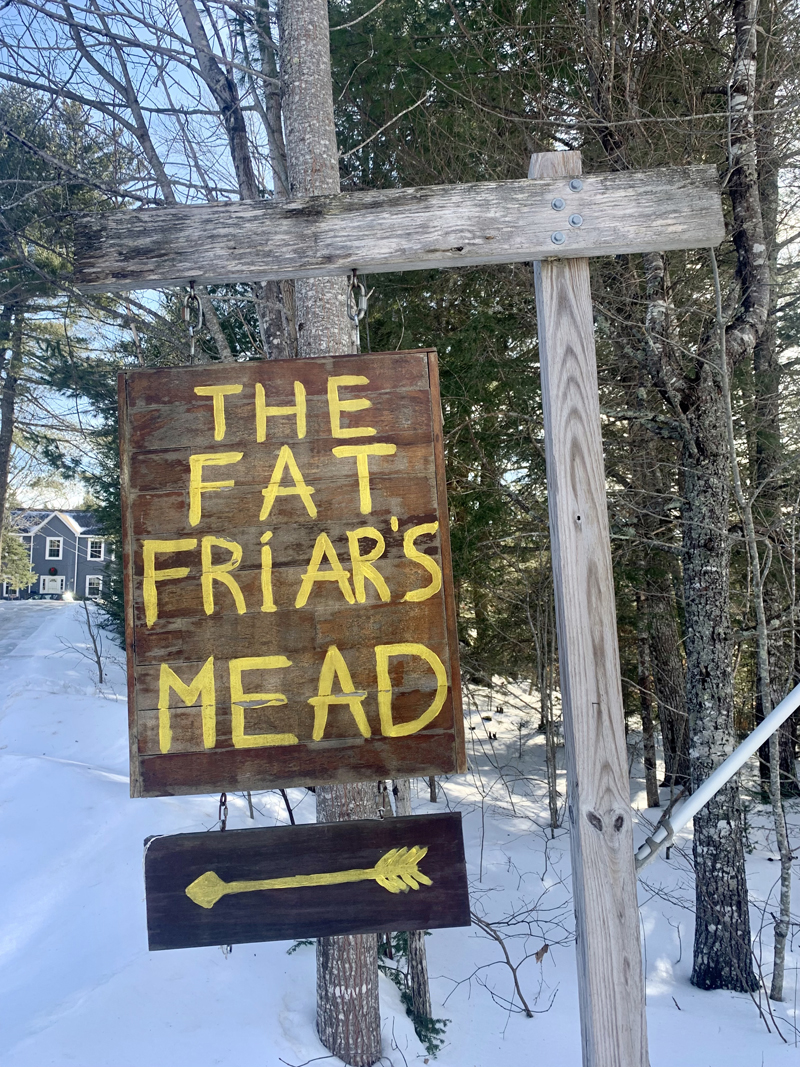
On a mid-winter Friday, the driveway leading to Fat Friar’s Meadery is a tundra. A hanging wooden sign with a yellow arrow points down the dirt lane towards Bailey’s house – and the meadery, which is located in his basement.

With his tucked-away facility, Bailey worries that people don’t know what mead is, or, even if they do, don’t know there are people making it in Maine.

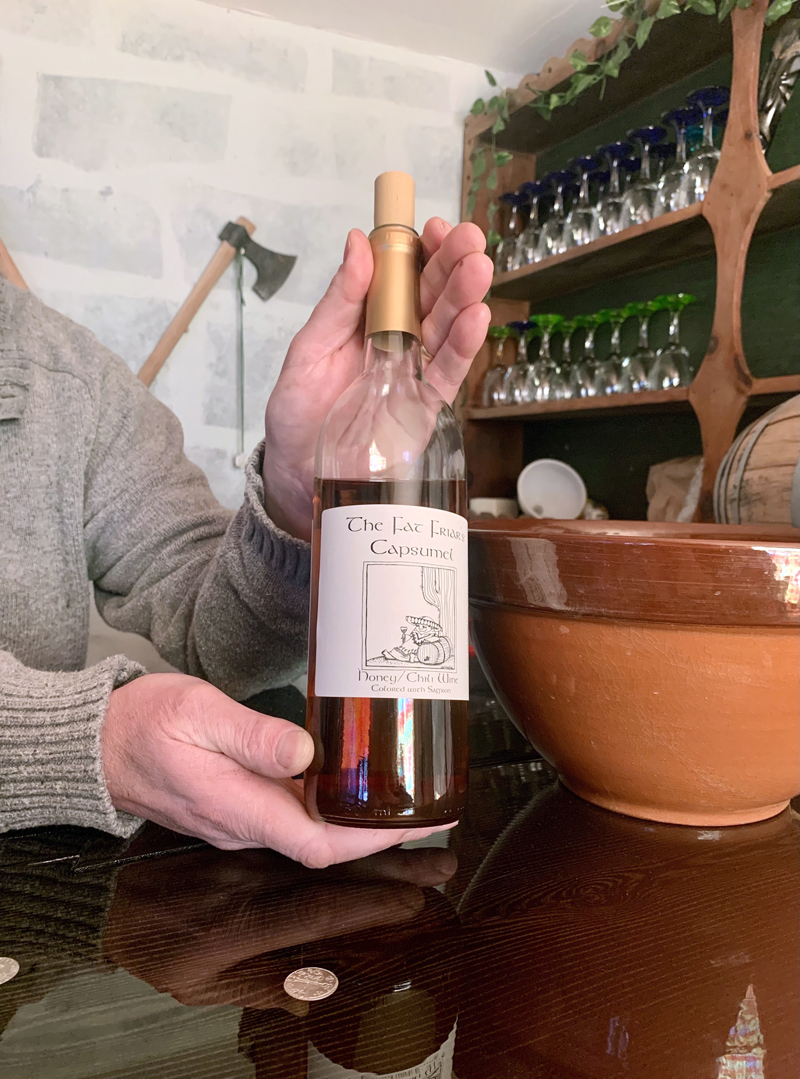
Bailey currently produces six kinds of mead: Original, black cherry, lemon and ginger, pepper, orange, cinnamon, and clove, and one that is hopped. Each recipe has a story and each label the characters from that story, sketched in ink.

In the winter, he tries to keep a rolling stock going; when he gets down to less than four cases, Bailey starts another batch.

He has two more flavours in the works, which he hopes to get fully approved this year. The first one is flavoured with sweet woodruff.

“Woodruff is a low-growing ground-covering herb. The Germans put it in their “berliner weisse” beers, and their May wines,” said Bailey, whose wife is German. “It smells like fresh-cut grass, it’s very herbal, so it tastes like a green tea with a hint of vanilla, and it gives a little bit of a green tint.”

The formula is approved but the label is pending with the name: the Burgermeister, Masterburger’s Waldmeister mead.

“A mouthful to say but what a mouthful it is,” said Bailey.

Sean Bailey holds a bottle of one of his six kinds of mead. Two more flavors are on the way. (Anna M. Drzewiecki photo)

Sean Bailey holds a bottle of one of his six kinds of mead. Two more flavours are on the way. (Anna M. Drzewiecki photo)

The second is flavored with maple syrup and spiced with basil, thyme, and rosemary. According to Bailey, it “tastes almost like a very sweet marinara without the tomato twang.”

The name is still brewing.

Outside, thick snow makes the downhill walkway to the tasting room almost impassable. Inside, under artificial light, mead ferments in grey plastic vats, lined waist high against the wall. Each vat yields about 90 bottles. It is some kind of sweet laboratory, some kind of small-scale techo-hive.

The first step in the process is sterilization. “Then you put the honey in and I put some boiling water into it to sterilize the honey, too, because you don’t want the bacteria,” added Bailey. But not for too long, lest the heat break down the complex sugar and protein chains in the honey.

Getting this right stops the mead from tasting “hot,” a word used to describe the alcohol burn flavor. Next, honey is chilled with cold water and spiced.

Then: Add yeast energizer, cut off the oxygen flow, and get out of the way.

“This one’s done fermenting,” said Bailey, walking over to one of the vats and pulling off its lid.

“See the little foam that’s going on in there? What we want to – see how cloudy that is in there? So we’ve got to get that stuff to settle out,” he added.

Bailey uses fining agents with different electrostatic charges to get “that stuff” to clump together and sink, before the new mead is filtered.

“The only difference between wine and mead is what you use for the sugars for the yeast to eat. So it’s honey versus grapes,” said Bailey.

Bailey sources his honey from New Hampshire. But bees on site are a dream.

“When I get a little more time, I’d like to keep a few hives, just for the sake of having some around,” he said.

Summer is just too busy. Bailey is a full-time painter, owner of Bailey & Son’s painting, now with his daughter. On rainy summer days, the painting crew may find themselves bottling mead or sanitizing vats.

With a little more time, Bailey also has plans for an outdoor gathering space. A picnic area, maybe, or fire pits.

A hand-painted sign points towards the mead-making hive off Route 215 in Newcastle. (Anna M. Drzewiecki photo)

A hand-painted sign points towards the mead-making hive off Route 215 in Newcastle. (Anna M. Drzewiecki photo)

“It would be nice to have a little fenced off area out back where people could just have a glass of mead and maybe some cold cuts and some crackers or breads,” mused Bailey. He’s drawn inspiration from other outdoor arrangements like Tin Top Cider in Whitefield and Odd Alewives in Waldoboro.

He’s working on tap service inside, too. And other inventive ways to bring in new customers, like his drink tokens for tasting flights.

“I’m not in this as a charity. I’m trying to make money,” said Bailey bluntly. “My goal would be to be self-sustaining.”

Bailey said he’s working on a five-year plan to transition away from painting towards the magic, mystery, and joys of mead-making – and full-time.

Magic, mystery, and joy resound in Bailey’s description of his first encounter with the fermented drink. He was traveling in Germany with his “then-girlfriend-now-wife.” They were at a small festival in her hometown, Bailey recalled.

“I came across this one guy that was just sitting at a nondescript table, with an earthen jar, and very small cups, no advertisement. I was like ‘Oh, well, whatever, let’s try it out.’ And he had what was called ‘honigwein,’ or honey wine, which is the same thing as mead just in a different language,” said Bailey. “I tried it and I thought: This is phenomenal, I’ve really got to try to make this.”

Bailey had already been brewing and fermenting for a few years, starting out with homemade beers and hard ciders. When he was finally able to buy an at-home winemaking kit, he was disappointed. It was boring, easy, just mixing a few ingredients.

“There’s no art to that,” said Bailey.

Painter and mead-maker Sean Bailey stands behind the bar he built in 2019 in his in-house tasting room. (Anna M. Drzewiecki photo)


When Bailey returned to the States, he bought some plastic honey bears from the grocery store, and “almost got carpal tunnel trying to squeeze all the honey out.” The first batch wasn’t very good, so he tucked it away in the cabinet.

Six or seven months later, in a late-night pinch, Bailey remembered the mead. With some extra time to ferment, he said, “It was actually kind of good.”

Bailey bought a book, started tweaking recipes, and got a hobbyist filtration machine.

When it came time to fill out his first license, the name was easy, sourced from a stranger who had called out “There goes the Fat Friar!” to Bailey while he was out on Halloween in Damariscotta dressed as a monk – and carrying a bottle of mead.

A lot has changed since then, and is still evolving. Bailey got his first bottler last year, which saves time and energy.

An Italian floor corker rests in the corner, plus a device to wrap gold foil around the top, another addition this year.

He no longer drives his own distribution runs, a relief from the long hours in the truck spent traversing Maine.

And, as of a few years ago, he can finally register his product as mead instead of honey wine with the state, as licensing language has adapted.

Bailey is an advocate for mead as much as he is an advocate for all small wineries, distilleries, and craft breweries in Maine. A map of the Maine wine trail – which includes Fat Friar’s – hangs in the tasting room above a display rack of mead.

“A lot of people are unfamiliar with how many wineries there actually are in Maine,” said Bailey, pointing to the map.

And having Oxbow Brewing Company down the road has actually been a big help.

“Newcastle can now boast its own distillery, a brewery, and technically I’m a winery, so you can do a pub crawl in northern Newcastle, who knew you’d ever be able to do that?” said Bailey.

“There’s good stuff coming from the area.”

In the tasting room – quiet on a winter weekday with no customers – Bailey painted the sheetrock walls to look like heavy slabs of stone. It’s a faux medieval tavern. There’s a red and black bar with old coins sealed into it, a wall-sconce. Custom mugs made out of cow horns, two axes crossed on the wall, and the overall sensation of time travel.

Bailey is an avid Medievalist, studying old recipes and participating in local groups that share the same interest. He’s ready for another time travel, too: To the spring.

“We’re anticipating spring will be busier. We’re doing the Bath winter markets this year, too,” said Bailey. But the tasting room won’t officially reopen until…well, “as soon as the ice is gone.” Bailey expects Mother’s Day.

For now, the little tavern is open informally and by appointment.

“If someone calls me up, I’m happy to open up for them,” said Bailey.

While Bailey finds support in other local wineries, distilleries, and breweries, he still wishes more people knew about Maine’s wine scene, including restaurants that consider themselves farm-to-table.

“They can tell you exactly where the potatoes come from, they can tell you exactly where the meat came from, they can tell you where everything comes from, and then you look and they have Californian, Oregonian, and Argentinian wines. It’s like, have you ever thought about wine in Maine?” Bailey said, “Half the time the wait staff says ‘We don’t make wine in Maine.’ And I just think: Oh, yeah we do.” 

https://lcnme.com/business/in-the-mead-ia-two-new-brews-coming-to-newcastles-fat-friars-meadery/#