Friday, 10 November 2023

From Beehives to Bottles: Cheers To The 2 Women Who Run One Of India's First Meaderies

From yourstory.com

Nashik-based Cerana Meads, the brainchild of Yoginee Budhkar and Ashwini Deore, crafts an alcoholic beverage from honey. It represents the coming together of their love for nature, fascination with honeybees, and appreciation of alcohol

Twelve years ago, when Yoginee Budhkar learnt about mead–an alcoholic beverage made by fermenting honey mixed with water and spices–from a UK-based professor, she was intrigued.  

Driven by unceasing curiosity, Budhkar began her search for the beverage locally, alongside her pursuit of a doctorate in biotechnology. However, she was unable to find the drink locally; so she began her own experiments to make some herself. 

Although her journey started as a mere passion, it eventually turned into something more.  In 2014, Budhkar shared the idea of setting up a meadery with her friend Ashwini Deore, a post-doctorate in bioprocess technology. In an instant, Deore decided to join Budhkar in her venture.  

After five years of research and development, Cerana Meads was established in 2019.  “Cerana Meads is a marriage of our love for nature, fascination with honeybees, and our appreciation of alcohol,” Budhkar tells HerStory.  Cerana Meads, she says, is the second company in India to get a licence for mead production.  

How it all began

                                                      Yoginee Budhkar (left) and Ashwini Deore (right)

Budhkar and Deore had always been passionate about science and nature. Both finished their doctorate from the Food Engineering and Technology Department at the Institute of Chemical Technology in Mumbai. During their college days, it was their shared interest in wine and nature that brought them together.  

Budhkar recalls her meeting with an investor at a party, who encouraged her to start making mead for commercial purposes as there was no big player in India. The idea struck her so deeply that she could not sleep that night.  

Later, she called Deore, who at that time was finishing her post-doctorate degree in Canada. The moment she heard the idea, Deore made up her mind to come back to India and start a venture together with Budhkar. 

“From being friends to co-founders, our bond has grown stronger,” says Budhkar.  

In 2014, the two friends started their research and development for making mead. They made several batches of mead, exploring different fruits and spices. Three years later, Budhkar even went to California to study advanced mead making at UC Davis.  

Back then, the Maharashtra state did not permit commercial fermentation of honey. So, the duo tried to persuade the excise department to amend the laws to enable the commercial fermentation of honey. Their efforts eventually paid off, and they obtained an approval from the state’s excise ministry in Mumbai in July 2017.

Following this, they took up a rental space in the Sinnar region of Nashik, Maharashtra. In December 2019, they obtained the final licence to produce mead. 

"We started building our product stock in January 2020, but COVID-19 hit and slowed us down. Things improved in June 2020 when the government allowed retail stores to reopen,” says Budhkar. At Cerana, Budhkar takes care of business development while Deore handles excise and meadery operations. Both of them manage the mead making together.

Crafting alcohol from honey 

Cerana offers a selection of meads with varying alcohol content: Pomegranate Vanilla, Jamun, Chenin Blanc, and Blue Pea Lavender, which have an alcohol content of less than 10% and come in 330-ml pints. It also offers Pinot Noir and Yule Spice, which come in 750-ml bottles and have 11.5% and 12% alcohol content, respectively. 

The company also produces other kinds of mead: melomel from fruits such as berries, apples, and peaches; pyment made with grapes or grape juice; and metheglin, which is infused with spices and herbs like cinnamon, clove and ginger.

The price of the products ranges from Rs 199 to Rs 810, depending on the size of the bottle. The company has produced 25,000 litres of mead so far.

Cerana Meads uses four kinds of honey: mustard honey procured from Rajasthan, litchi honey from Bihar, multi-floral honey from Himachal, and jamun honey from the Satpura region along the Maharashtra-Madhya Pradesh border.  After the honey is procured, a quality analysis is done at the production unit in Nashik, which is spread across 3,500 sq feet. Then the honey is mixed with water and kept aside for fermentation. 

“We have SOPs (standard operating procedure) for different types of meads and the process differs accordingly,” says Deore.  Once the fermentation process is complete, the mead is clarified, stabilised, filtered, carbonated, if needed, and then carefully bottled. Deore notes that meads with a higher alcohol content are non-carbonated, while those with lower alcohol content are carbonated. Budhkar points out that honey is extracted only from the ‘super chamber’ of the bee boxes, where bees store surplus honey.

"In the super chamber, honeybees meticulously use certain techniques to reduce the honey’s moisture content, sealing it with wax. Our meads are crafted from sealed comb honey, which is not subjected to any artificial moisture removal process,” she says. She explains that sealed comb honey contains lower moisture levels and hence an extended shelf life. If it isn’t sealed, the honey is premature and requires artificial removal of moisture, which can diminish the subtleties of flavour and affect natural taste.  “Taking honey from the brood portion of the bee box could also disrupt the bees,” she adds.

To ensure honey is harvested from the surplus portion of the hive, the duo either supervises the extraction process in person or monitors it via video.  

They believe traditional wine and beer production often involves the use of agricultural land, treated with chemicals, which can have detrimental effects on the environment. On the other hand, mead making does not inflict any harm on the bees and the surrounding environment, they say.  

“Mead making relies primarily on honey as its raw material, with the process designed to ensure no harm is inflicted on the bee population or the environment. Additionally, we use locally sourced ingredients in our meads, which are gluten free and without any synthetic additives,” says Budhkar. 

The start-up has a team of nine people including the founders. The D2C brand sells its products through alcohol outlets in Pune, Nashik and Mumbai in Maharashtra. It also sells honey through its website. The founders plan to expand their business to Bengaluru, Delhi and Goa and launch new products by next year. 

Challenges in the industry 

Cerana offers a selection of meads with varying alcohol content: Pomegranate Vanilla, Jamun, Chenin Blanc, and Blue Pea Lavender, Pinot Noir, and Yule Spice. It also produces other kinds of mead: melomel from berries, apples and peaches; pyment from grapes; and metheglin using spices and herbs

Speaking on the challenges in the industry, Budhkar says alcohol is a highly regulated substance in India and thus approvals take time to come through. 

“Navigating compliances is a time-consuming and resource-intensive process for start-ups like ours,” she says, adding that building a good team for production is another challenge and the staff needs to be trained from scratch.  On the consumer front, there are two distinct issues to be addressed. One involves introducing a whole new category to a market that is habituated to beer, wine and hard liquor. Secondly, the Indian market is largely a price sensitive one. 

"For a craft alcohol brand like ours where quality takes precedence over cost of manufacturing, it is a challenge to maintain the balance between quality and price,” says Budhkar. 

Talking about their experience as women entrepreneurs, Budhkar says, “It is natural to think that women would find it difficult to find their space and comfort in this industry, as it has largely been male-dominated. However, our first-hand experience has been that this is probably the most gender-neutral industry to work in. We have not had to face any challenge that our male peers haven’t faced themselves.” 

“We haven’t faced a bias or suffered any stigma on account of being women in the industry. Additionally, our families have been very supportive of our choices and journey,” she adds. 

Saturday, 4 November 2023

UK: Gosnells rebrands sparkling meads in bid to steal share from cider

From thegrocer.co.uk

Urban meadery Gosnells is to rebadge its sparkling honey-based drinks as ‘Nectars’.

The move to rebrand its meads would help Gosnells tap into and revive the cider category, according to founder Tom Gosnell.

The category – worth £1.2bn in grocery [NIQ 52 we 9 September] – was “stagnant” and lacked “the innovation and premiumisation seen in other alcohol categories”, Gosnell said.

“Mass-produced ciders are often laden with refined sugars and synthetic additives, which are out of step with the contemporary consumer’s desires,” he said.

Gosnells’ range of Nectars, he added, could “fill this void” by offering drinkers “an innovative range of low-sugar, gluten-free beverages that don’t compromise on flavour”.

The brand’s session-strength meads – typically those under 6% abv – have already been rebadged as Nectars in the on-trade. Its cans will start to roll out in the new year.

Gosnells’ higher abv and still drinks would retain the mead badge to clearly differentiate them from the products it offered on draught and in 440ml cans, Gosnell said.

“The way that people use these drinks is different,” he said. “Our fizzy pints and tins of Nectar are designed to be consumed like a beer or cider. Our more traditional meads are more like wines.”

Early feedback to the change from the on-trade had been “really positive”, helping to improve rate of sale and understanding of what the products were, he added.

                              Gosnells meads could help revive the cider category, founder Tom Gosnell said


The move came as Gosnells announced a £500,000 equity raise.

The south London drinks company said it would use the funds – half of which have already been committed by existing shareholders – to expand in the on-trade, and build a second bar to go alongside its inaugural venue in Bermondsey.

Gosnells drinks are stocked in venues including Daisy Green, Cubitt House, Drake & Morgan and Brewdog, as well as independent pubs and restaurants across London.

Gosnell said overfunding would enable the mead-maker to ramp up its efforts in the off-trade, which presently only accounts for 25% of sales.

“We’d love to get a grocery listing but it’s really competitive, especially in the cider space,” he said. “Right now, our aim is to build awareness in the on-trade to the point where supermarkets are clamouring for it.”

https://www.thegrocer.co.uk/alcohol/gosnells-rebrands-sparkling-meads-in-bid-to-steal-share-from-cider/684956.article 

Friday, 6 October 2023

Mead is on the rise as brewers target a younger crowd

From thecaterer.com 

Mead is growing in popularity due to a new wave of brewers targeting a younger crowd. Meet producer Tom Gosnell

What does Norse mythology have in common with an industrial estate in London's Peckham? The answer is mead, the honey-flavoured drink believed to be one of the world's oldest alcoholic beverages. Archaeologists have found evidence of its presence in Chinese pottery dating from 7000 BCE and it's mentioned in the works of Ancient Greek philosopher Aristotle and the Old English epic poem Beowulf. But can mead be marketed to a 21st-century crowd?

That's the mission of Tom Gosnell, who founded London's first and only meadery, Gosnells, in 2014. Although its mead is produced in Peckham, in 2022 the team opened their first taproom on the Bermondsey Beer Mile, joining the craft beer and cider brewers that make up the popular drinking trail.

"I'd always been interested in fermentation and making alcohol," says Gosnell. "I used to make cider and started getting interested in honey. Bees are amazing creatures that are important to all our ecosystems. I wanted to take that natural product and turn it into drink and that's where we started from."

In its simplest form, mead is made by fermenting honey and water to create a pale-yellow alcohol, sometimes with the addition of fruits or spices. Its alcohol content can range from around 3.5% ABV to more than 20% ABV and it can be still, carbonated or naturally sparkling.

Mead can take on different flavours depending on the diet of the bees producing the honey. Gosnell's core range is created using honey from an area full of orange blossom, which gives the drink a light, crisp citrus flavour at 5.5% ABV. Other varieties include a pink Hibiscus mead, made with European blossom honey packed with dried hibiscus flowers (4% ABV), and a Citrus Sea mead blended with lemon, tarragon and hops with a saltier finish (4% ABV).

The global mead market was worth $432m (£345m) in 2020 and is projected to grow to over $1.6b (£1.3b) in 2028, according to Fortune Business Insights. Gosnell says there is a rise in brands entering the space and he is keen to market mead as a modern, sustainable drink, rather than focusing on its history.

Sweet success

Since its opening last year, the Bermondsey tap room has helped the mead brand reach a wider, urban crowd.

"It gets absolutely packed [there] on a sunny day," says Gosnell. "It's been really good for us to broaden our audience a bit. We talk about bees and honey more than we talk about any of the negative historical connotations around Beowulf or Vikings. We're really far away from that. We're really proud of the liquid we make and want everyone to enjoy it and understand the link with the honey and the natural world."

The bid to broaden mead's appeal so far seems to have paid off. Gosnells is stocked in around 75 hospitality venues, including the Daisy Green Collection, Drake & Morgan and BrewDog. Some 70% of the sites, which are mostly in London, pour Gosnells on draught while the other 30% stock its cans.

Gosnell is passionate about sustainability and is keen for the business to remain ethical as it grows. The company is in the midst of an audit by B Corp, a non-profit which gives accreditation to businesses aiming to have a positive impact on people and the planet. This rigorous assessment of its environmental, social and governance policies is expected to take around 18 months and Gosnell hopes the meadery will gain certification by the end of the year.

"Something we are constantly working to is looking at how we reduce our [carbon] footprint as a business," he explains. "It's hard to make a specific claim against other products, but, compared to beer, [mead] is a lot less energy-intensive. You're not breaking down the grain to make sugar – the sugar is there in the honey. From that perspective, it's probably slightly more sustainable in terms of carbon footprint."

This sustainable ethos has extended into several of Gosnells' partnerships. For every pint of its Wild Flower Mead sold, the meadery donates 5p to support the Bumblebee Conservation Trust, a charity which works to protect bees and other pollinators from a decline in their numbers.

Fishy business

Over the summer, the Bermondsey taproom has been hosting crawfish boils, serving customers the invasive American signal crayfish by the bucket. These events have seen Gosnells team up with Bob Ring, also known as ‘Crayfish Bob', an expert who has a licence to harvest the species from UK waters to protect the indigenous population.

Gosnell admits his sustainable focus can sometimes clash with the company's commercial aims, but says the meadery tries to marry the two together.

"Recycling is a classic example, it makes good financial sense because it's cheaper than normal waste. Or making sure the lights are turned off and reducing our energy consumption because it saves us money. There are a lot of things that go hand in hand."

Gosnells is looking at securing investment to help it expand into more pubs and restaurants and has plans to open a second retail location next year.

"It's really important for us as a young company to build a good company that people want to work for and want to buy from," adds Gosnell. "We're definitely not making the world a worse place."

https://www.thecaterer.com/sector/pub-bar/mead-on-the-rise-target-younger-crowd

Wednesday, 4 October 2023

Honey Wine Market is Estimated to Observe Significant Growth 2023 to 2032

From benzinga.com

The Global 
Honey Wine Market
 had a valuation of USD 455 million in 2022 and is projected to reach USD 875 million by 2032, with a forecasted revenue compound annual growth rate (CAGR) of 8.5%. Several key factors contribute to this market's revenue expansion.


One primary driver is the increasing demand for artisanal beverages worldwide. Consumers have displayed a growing preference for locally sourced, unique, and premium-quality drinks, leading to significant growth in the craft beverage sector. Honey wine, characterized by its distinctive flavour profile and unique brewing process, has gained considerable popularity among consumers as an artisanal beverage.


Furthermore, heightened awareness among consumers regarding the health benefits associated with honey wine consumption is fuelling market growth. Honey wine is known for its anti-inflammatory and antioxidant properties, as well as potential advantages for digestive and immune system health. As a result, it is being increasingly chosen by consumers as a healthier alternative to conventional alcoholic beverages.

Competitive Landscape:

The global honey wine market is growing steadily, with a few major players dominating the market. The market is expected to continue to grow due to increasing consumer interest in natural and organic products, as well as the rising popularity of honey wine among young adults. Some of the major players in the global honey wine market are:
  • Meadery of the Rockies
  • Monks Meadery
  • Heidrun Meadery
  • Redstone Meadery
  • Dansk Mjød
  • Hidden Legend Winery
  • Bunratty Mead and Liqueur Company
  • Nektar Naturals
  • Schramm's Mead
  • Viking Braggot Company
Strategic Development:
  • In 2021, Meadery of the Rockies launched a new line of honey wine called "Mountain Honey Wines." These wines are made from locally sourced honey and are available in a range of flavors, including huckleberry, raspberry, and peach. The launch aimed to expand the company's product offerings and cater to the growing demand for flavored honey wines.
  • In 2020, Monks Meadery announced a partnership with a major online retailer to increase the distribution of their honey wines. The partnership aimed to increase the brand's visibility and expand its customer base by reaching new markets and regions.
  • In 2020, Heidrun Meadery introduced a new line of honey wine called "Sparkling Mead." These wines are made using traditional champagne methods and are available in dry, semi-dry, and sweet varieties. The introduction of the new line aimed to cater to consumers' increasing interest in premium honey wines and expand the company's product portfolio.

Sunday, 1 October 2023

A Season for Cider & Mead

From myneworleans.com

In the United States cider is a fermented beverage made from unfiltered apple or pear juice. Styles can be sweet or dry, carbonated, or still. To make mead, fermented honey (and sometimes spices, fruit, hops, and other agricultural products) are mixed with water. But no honey, no mead. Fermented honey must be present. 

The alcohol content in in hard cider varies from less than 3% for one in the style of the French cidre doux, to 8.5% – 12% for a hard cider in the traditional English style. The alcohol volume in mead can reach a walloping 20 %.


Mead came first. It is believed to have been concocted by accident by nomadic Africans. In the process of pollinating flowers bees gathered traces of adaptive, wild yeast, which then turned up in their honey, creating the ingredients needed for fermentation. Nomads collected rainwater in tree stumps and spaces where bees had their hives. They liked the taste, and they liked the buzz. Life back then was probably a weird combination of terror and boredom, so the buzz spread quickly about the feel-good stuff, soon making its way to China, then Europe, where the sea-faring Vikings made it their beverage of choice. No one understood the process of fermentation. Some thought it was magic, others, like the Greeks, gave mead a spiritual connotation. Meads lost their popularity with the rise of wine. Grapes were abundant and cheap compared to honey. 

As with so many things gustatory, the first recorded history of the consumption of cider dates to the time of Roman rule. In 55 BCE Julius Caesar observed the Celtic Britons fermenting cider from native crabapples. Cider remains popular with the Brits as well as the French in the regions of Brittany and Normandy. The Puritans planted apple trees shortly after hitting Plymouth Rock and most homesteads had an apple orchard, making cider the most common beverage in the colony. Even children drank it in a diluted form as the water was often fetid and the alcohol killed the parasites. In 1899 the U.S. produced 55 million gallons of hard cider.

Cider production fell as people moved from farms to cities and beer consumption rose due to demand by newly arrived German and Irish immigrants and the availability of inexpensive grain in the Midwest. By 1919 when Prohibition was enacted, cider production had fallen to 13 million gallons. No concrete records exist, but it is safe to assume the at-home production of cider rose once again with those not interested in government-mandated teetotalling.

In recent years there has been a resurgent interest in cider and mead, making it one of the fastest-growing segments of the liquor industry.

What to serve with Dry Cider and Mead

“Mead is hard to pair,” Moore said. “Fresh goat cheese and bread are about it.” Moore and Powell suggest serving dry ciders with cheese and charcuterie. “The cider is acidic, and the cheese and charcuterie are fatty and salty, making the pairing a match made in heaven.” 

https://www.myneworleans.com/a-season-for-cider-mead/ 

Saturday, 23 September 2023

The oldest alcoholic beverage is making a comeback

From spectrumlocalnews.com

MADISON, N.C. — The oldest known alcohol in the world is mead. It’s made of honey, yeast and water and has gained popularity from medieval-style shows such as "Game of Thrones" and the "Lord of the Rings" movie series.

What You Need To Know

  • Mead is the oldest known alcoholic beverage in the world 

  • It is made of honey, yeast and water 

  • Mead is gaining popularity through medieval shows and movies 

It’s called the nectar of the gods and with at least 16 meaderies across the state, the golden-coloured drink is making a statement across North Carolina. 

Trevor Ogle is the co-owner and mead maker at Wandering Sun Meadery, and after studying in Kazan, Russia, he fell in love with mead. 

“When I was in Russia, I found a lot of mead. And I was really excited about it, because I tried it. It was really good. Then I got back here, and you couldn't find it anywhere,” Ogle said. 

Ogle has lived many lives from being in a 1980s and '90s tribute band, a teacher and studying pre-med and Russian. Using all of this knowledge, he is able to make the best version of his mead possible. 

“Oh, this is definitely basic basic biochemistry. That's what brewing is. So just chemistry and biology together. Chemistry and biology together makes this work, makes it a lot easier, makes you kind of understand more what you're doing and why you're doing it,” Ogle said. 

He says the process starts like any alcoholic drink, with the fermentation process his favourite part. 

"It's just really neat," Ogle said. 

For 500 litres of mead, he says he uses around 360 pounds of local honey from the Rockingham and Stokes County areas. 

“You get the fermentation so strong that you open up one of those larger tanks, and it just looks like there's a propeller at the bottom stirring everything up, and nothing's going on. It's so strong that the yeast are putting out alcohol and carbon dioxide that it literally just churns it as if there's like a propeller in there,” Ogle said. 

He says his mead can be ready in about two to two and a half weeks, far from the common misconception about the ancient beverage. 

“There's this myth that you can't drink a mead until it's a year old, and that is totally a myth,” Ogle said. 

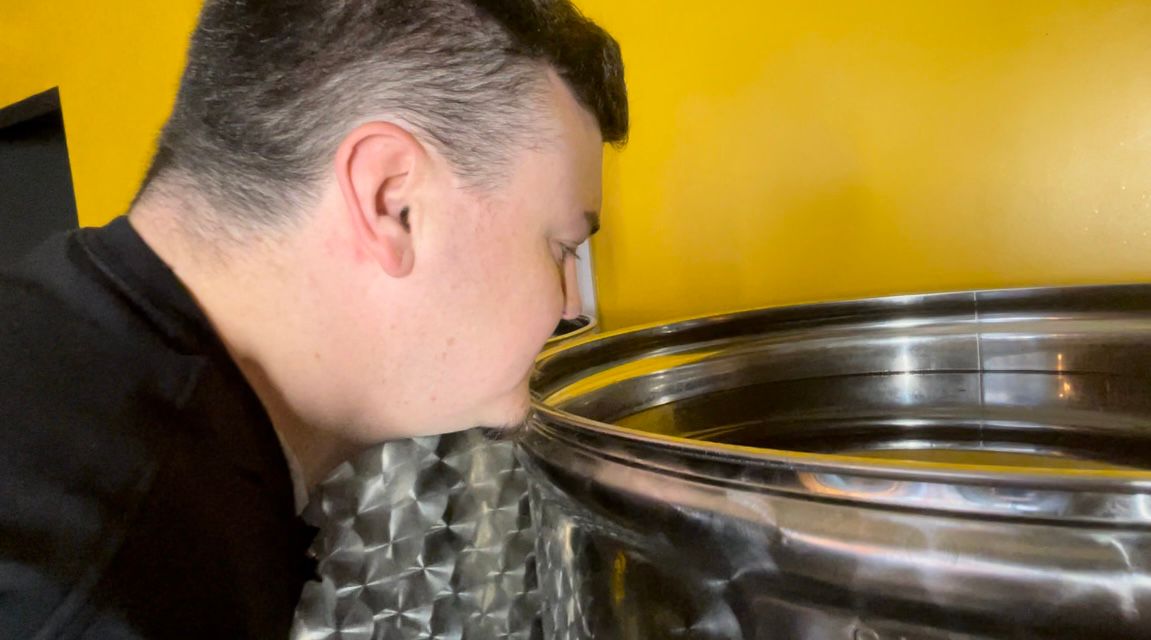
Ogle smelling the fermentation process of his mead.
Trevor Ogle smelling the fermentation process of his mead. (Spectrum News 1/Sydney McCoy)

After a good sniff test, he knows his mead is ready for the next step. 

“It gets up to 12%. At that point, we can clarify it and filter it to make it nice and clear and take the yeast back out of it. And after it's clarified, we will put it into separate containers and flavour it up with spices, herbs, fruits, whatever we want,” Ogle said. 

Ogle says it's important to make sure his equipment is clean to help enhance the flavour and quality of the mead. But if any stray bacteria or yeast gets left behind, the fermentation process can ruin the product. 

“There's an old joke that if you want to own a meadery, winery, brewery, you get used to washing dishes, because that's pretty much all you're going to do,” Ogle said.

After more filtration, the mead is ready for bottling. 

He says he makes a pretty mean orange blossom traditional, and some of his favourite flavours are his custom Viking, Pineapples of Paradise and says his best is probably his traditionals. 

“So I think my honestly, my best are my traditionals. Traditional mead is notoriously difficult to make because there's nothing really in it. It's just honey, yeast and water. And so it can be very challenging," Ogle said. 

He says his secret is keeping the mead flavour in it, which is what makes it unique. 

“I think it's just a good solid mead and has a good mead flavour. There was a mead judge that actually came by one time to try to mead, and he said that was the mead-est mead that he had ever tasted,” Ogle said. 

Medals won by Wandering Sun Meadery earlier this year.
Medals won by Wandering Sun Meadery earlier this year. (Spectrum News 1/Sydney McCoy)

Regardless of what flavour of mead you may try, one thing is for sure, mead is neither a wine nor a beer. 

“And it's really its own beverage. So that makes it kind of stand out. It has a flavour that is kind of like a wine, but it really is completely unique,” Ogle said. 

He says its uniqueness makes the drink appeal to the masses and says you just have to try it!

“It’s kind of a combo, it's its own thing. Yeah. It appeals definitely to beer drinkers. It appeals to wine drinkers. It appeals to people that like sweet wine. People like dry wine, because you really can't make it kind of anywhere you want,” Ogle said. 

Wandering Sun Meadery has won numerous awards, including silver medals for its traditional off-dry mead and semi-sweet mead, as well as a bronze medal for its traditional dry mead at the 2023 NC Wine Competition. 

https://spectrumlocalnews.com/nc/charlotte/news/2023/09/22/wandering-sun-meadery-mead-

Tuesday, 19 September 2023

Wye Valley Meadery drink awarded Great Taste Golden Fork

From southwalesargus.co.uk 

A traditional mead in Monmouthshire has scooped a Great Taste Golden Fork award

The Great Taste Golden Fork trophy for Wales has been awarded to Hive Mind Mead & Brew Co. from Monmouthshire, for its Wye Valley Meadery Traditional Mead.

                                     Matt and Kit Newell received the Wales Golden Fork award (Image: Guild of Fine Foods)


Kit Newell, co-founder of Hive Mind Mead & Brew Co, said: “It is a huge honour to be awarded the Golden Fork, especially given the amazing quality of food and drink represented by the entries to the awards.

“This recognition is testament to the passion and dedication of our small team as we work together to craft unique meads which tell the story of our beautiful region, its biodiversity and the quality of the honey it provides."

More on the Traditional Mead:

Described as a “gorgeous pale-yellow mead”, the Traditional Mead is crafted in the  Wye Valley in the Welsh Borders by a small, family run company that takes the world’s oldest form of alcohol and gives it a modern twist.

It impressed the Great Taste judges with its “glorious blossom aroma with woody, earthy elements and a citrus sourness, hinting of fermentation” at every stage of the blind-tasted judging process across 89 days in Dorset and London.

                                                                  Image: Hive Mind Mead & Brew Co


Great Taste’s prestigious judging panel is made up of more than 500 food and drink professionals. This experienced panel, each with trusted palates, have together tasted and re-judged the three-star winning products to determine the Golden Fork winners, as well as the Great Taste Supreme Champion of 2023.

The Great Taste Golden Fork from Wales was sponsored by Food & Drink Wales. Also nominated this year were the Great Taste 3-star Pedigree, Organic, Pasture-fed Hogget Leg from Black Welsh Lamb based in Abergavenny, Monmouthshire, and Cold Pressed Sunflower Dressing Oil from Mountain Produce based in Wrexham.

The full list of this year’s winners can be found at www.greattasteawards.co.uk 

https://www.southwalesargus.co.uk/news/23791796.wye-valley-meadery-drink-awarded-great-taste-golden-fork/